A wooden slant board can make calf stretching, ankle-mobility work, squats, and rehabilitation exercises easier to perform consistently. The right model should feel stable under load while offering an incline that suits your flexibility and training goals.
We compared these 10 options by adjustability, surface grip, portability, weight capacity, size, and versatility so you can choose a board that fits your routine and available space.
Best 10 Wooden Slant Boards Picks for 2026
StrongTek Classic

- Five angles from 15° to 35°
- Hardwood plywood construction
- Anti-slip surface with carry handle
Best For: Stretching, rehabilitation, squats, and general mobility work
Pro Capacity Pick
500 lb Adjustable Wooden Slant Board
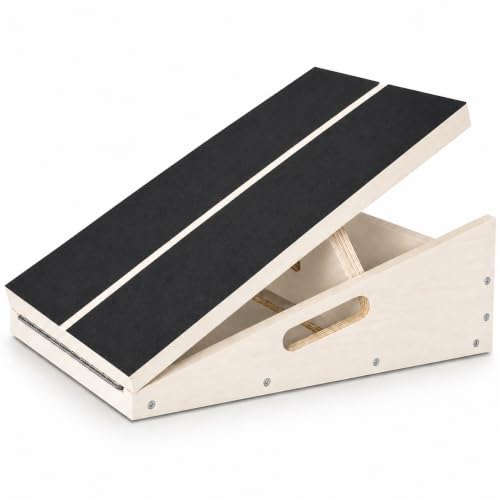
- Supports up to 500 pounds
- Five adjustable stretch angles
- Includes guide and three-year warranty
Best For: High-capacity stretching, mobility, squats, and warm-ups
Wide-Fit StrongTek
Foldable Wide Wooden Slant Board

- 13-inch-wide exercise platform
- Five angles from 15° to 35°
- Folds flat with anti-slip grips
Best For: Wide-stance exercises, mobility work, and portable storage
Compact Mobility Option

- Four angles from 20° to 40°
- 500-pound stated capacity
- Folds with handle and magnetic closure
Best For: Portable stretching, office mobility breaks, and compact storage
Best Foldable Wooden Slant Board
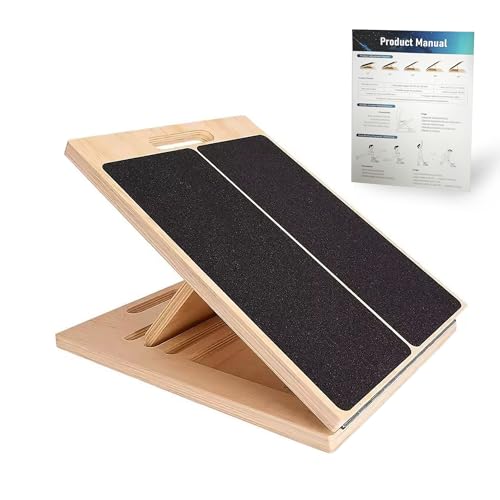
- Five incline settings from 20° to 45°
- 350-pound capacity with a non-slip surface
- Folds flat and arrives fully assembled
Best For: Home workouts, mobility, and rehabilitation
Best High-Capacity Wooden Slant Board

- 460-pound capacity with a lightweight design
- Five angles from 23° to 45°
- Textured PVC surface and EVA anti-slip base
Best For: High-capacity stretching and mobility routines
Best Wooden Slant Board With Bands

- Five adjustable angles for stretching and training
- Layered wood construction supports about 300 pounds
- Includes two resistance bands and a carry handle
Best For: Stretching, rehabilitation, and band-assisted strength work
Portable Adjustable Pick
Lightweight Wooden Slant Board

- Weighs about 4.5 pounds for portability
- Four incline settings from 30° to 45°
- Designed for stretching, squats, and rehabilitation
Best For: Beginners and active adults needing an adjustable board for home, gym, or therapy use
Dual-Function Choice
Wooden Balance and Slant Board

- Combines balance-board and slant-board functions
- Four adjustable incline positions
- Includes non-slip and floor-protection features
Best For: Multi-purpose home, therapy, or standing-desk routines
Heavy-Duty Mobility Pick
TEMI Adjustable Wooden Slant Board

- Four angles from 20° to 40°
- Stated 500-pound weight capacity
- Built-in handle and non-slip surface
Best For: Mobility training, rehabilitation, squats, and higher-load stretching
StrongTek Classic – Adjustable Wooden Slant Board
This adjustable wooden slant board is designed for calf and ankle stretching, warm-ups, recovery work, and squats. Its five incline positions and textured anti-slip surface make it a practical option for different fitness levels, while the side handle helps with portability.
Best For: Home users who want a sturdy, adjustable board for stretching, rehabilitation exercises, and mobility work.
Pros:
- Five adjustable angles from 15° to 35°
- Made from high-quality Lauan hardwood plywood
- Anti-slip treads and an integrated side handle
- Arrives assembled and ready to use
Cons:
- At 9 pounds, it is heavier than some portable alternatives
- The listed dimensions may take up more storage space than compact folding boards
Choose this model if durability, a full-coverage non-slip surface, and straightforward angle adjustment matter more than minimizing weight. It is a solid all-purpose choice among wooden slant boards.
Pro Capacity Pick – 500 lb Adjustable Wooden Slant Board
This wooden slant board combines five adjustable calf-stretching angles with a stated 500-pound capacity. The textured top and slip-resistant base support controlled stretching, ankle mobility, calf raises, squats, and warm-ups at home, in the gym, or in an office.
Best For: Users who prioritize a high weight capacity, guided exercise ideas, and versatile mobility training.
Pros:
- Five settings from 15° to 35°
- Rated for up to 500 pounds
- Textured standing surface and slip-resistant base
- Includes a visual exercise guide and three-year warranty
Cons:
- Its 3.85 kg weight makes it less lightweight than some folding options
- The board is listed in a natural wood style with a yellow finish, which may not suit every setup
This is a strong fit for buyers seeking a substantial wooden slant board with clear angle progression and extra reassurance from the capacity rating and warranty.
Wide-Fit StrongTek – Foldable Wide Wooden Slant Board
This wide wooden slant board provides five settings from 15° to 35° and a 13-inch platform for calf stretches, squats, lunges, and ankle mobility work. Its foldable design, carry handle, abrasive top, and rubber bottom pads make it convenient for storage and transport.
Best For: Beginners, athletes, and rehabilitation users who want a wider stance area and compact storage.
Pros:
- Extra-wide 13-inch platform for more natural foot placement
- Five adjustable angles from 15° to 35°
- Supports up to 350 pounds
- Folds flat and includes an integrated carry handle
Cons:
- Its 350-pound capacity is lower than some 500-pound models
- The foldable structure may be less convenient for buyers who prefer a permanently rigid board
Consider this model when platform width and portability are priorities. The dual anti-slip design and fold-flat profile give it a useful balance for home gyms, clinics, and travel.
Compact Mobility Option – Folding Wooden Slant Board
This folding wooden slant board is built for portable calf stretching, ankle mobility, warm-ups, and recovery routines. It offers four incline positions from 20° to 40°, a non-slip foot surface, bottom grip pads, a carry handle, and a magnetic closure for compact storage.
Best For: Office workers, home users, and gym-goers who need a portable board that folds away easily.
Pros:
- Folds to a compact profile for storage and transport
- Four adjustable positions from 20° to 40°
- 12-layer wood construction with a stated 500-pound capacity
- Carry handle and magnetic closure support portability
Cons:
- It offers four positions rather than the five found on several competing models
- The supplied specifications list a one-year warranty
This is the most storage-friendly choice in the group. Pick it if you want wooden slant boards for regular mobility breaks without leaving a full-size platform permanently set up.
Best Foldable Wooden Slant Board – Adjustable Calf Stretcher
This wooden slant board is a practical choice for home workouts, mobility routines, and rehabilitation. It offers five incline settings, a non-slip surface, and a 350-pound capacity, while folding flat for convenient storage.
Best For: Beginners, athletes, office workers, and users who want a foldable board for calf stretching, squats, Pilates, yoga, or physical therapy.
Pros:
- Five adjustable angles from 20° to 45° for progressively challenging stretches.
- Non-slip surface and 350-pound weight capacity provide a stable platform.
- Folds flat, arrives assembled, and weighs 5 pounds for easier storage and transport.
- Can support calf stretches, squats, Pilates, yoga, and rehabilitation exercises.
Cons:
- The listed dimensions may be less suitable for users who prefer a larger platform.
- It is heavier than some similarly sized portable wooden slant boards.
Choose this model if storage convenience matters as much as adjustability. Its foldable design and broad range of angles make it versatile for daily mobility work, though shoppers seeking the lightest option may want to compare weights.
Best High-Capacity Wooden Slant Board – Portable Calf Stretch Board
This wooden slant board stands out for its 460-pound capacity and traction-focused construction. Its five angle settings, textured PVC surface, and EVA base make it suitable for controlled calf stretches, warm-ups, squats, and lower-body mobility work.
Best For: Users who want a high-capacity, portable incline board for stretching, physiotherapy, rehabilitation, gym routines, or office mobility breaks.
Pros:
- Supports up to 460 pounds while weighing about 4 to 4.5 pounds.
- Five angle settings from 23° to 45° accommodate different flexibility levels.
- Textured PVC top and non-slip EVA base help provide traction.
- Includes a training poster and instruction guide, and requires no tools to set up.
Cons:
- The black PVC-and-EVA construction may appeal less to shoppers seeking an all-wood appearance.
- Angle changes require manually positioning the support panel in the selected slot.
This is a strong fit when weight capacity and traction are priorities. It also offers useful guidance for new users, while its manual angle adjustment keeps the design straightforward rather than highly automated.
Best Wooden Slant Board With Bands – Hardwood Calf Stretch Board
This wooden slant board combines five adjustable angles with a layered hardwood construction and anti-slip features. It is designed for calf stretching, squat support, rehabilitation, and lower-body strength work, and it includes two resistance bands for added exercise options.
Best For: Users seeking a portable wooden slant board for stretching, rehab, strength training, and band-assisted workouts at home or in the gym.
Pros:
- Five adjustable angles allow users to tailor stretching and exercise intensity.
- 11-layer pressed wood construction supports loads of about 300 pounds.
- Anti-slip sandpaper surface and bottom pad help improve stability.
- Foldable design includes a carry handle and two resistance bands.
Cons:
- Its approximately 300-pound capacity is lower than the highest-capacity option in this roundup.
- The included resistance bands may be unnecessary for shoppers focused only on calf stretching.
- At 4.8 pounds, it is not the lightest board listed.
This model makes sense for shoppers who want more than a dedicated calf stretcher. The included bands and foldable carry design broaden its training potential, while the 300-pound capacity is best matched to users within that limit.
Portable Adjustable Pick – Lightweight Wooden Slant Board
This portable wooden slant board is a practical option for calf stretching, squats, Pilates, and rehabilitation exercises. Its four incline settings make it easy to adjust the stretch or exercise angle at home, at the office, in a gym, or in a physical therapy setting.
Best For: Beginners, athletes, and adults seeking a lightweight adjustable board for stretching, mobility work, or recovery exercises.
Pros:
- Lightweight design weighs about 4.5 pounds for easier transport.
- Four adjustable angles: 30°, 35°, 40°, and 45°.
- Suitable for calf stretching, squats, mobility work, and rehabilitation routines.
- Compact wooden construction can be used in several settings.
Cons:
- Its listed angle range starts at 30°, so it may not suit users seeking lower inclines.
- The notes do not mention a built-in handle or specific non-slip surface.
Choose this model if portability and straightforward angle adjustment matter most. It covers common stretching and weight-bearing uses without adding the extra balance-board function found on some alternatives.
Dual-Function Choice – Wooden Balance and Slant Board
This 2-in-1 wooden slant board combines an adjustable incline board with a balance board, making it a flexible choice for stretching, physical therapy, core work, and standing-desk use. Four incline positions allow users to vary the setup for different routines.
Best For: Users who want one compact wooden board for calf stretching, balance training, rehabilitation, and standing-desk posture support.
Pros:
- Functions as both a balance board and a slant board.
- Offers four adjustable incline positions.
- Heavy-duty wood is listed with a maximum weight recommendation of 350 pounds.
- Includes a non-slip surface, antiskid feet, and floor-protection pads.
Cons:
- The balance-board function may be more equipment than needed for simple calf stretching.
- The supplied notes do not specify the exact angles of the four incline positions.
This is the most versatile option of the three for buyers who want more than a fixed stretching platform. Its balance function and standing-desk applications broaden its usefulness, while the safety features support everyday practice.
Heavy-Duty Mobility Pick – TEMI Adjustable Wooden Slant Board
The TEMI wooden slant board is built for calf stretching, squats, heel stretches, and ankle-mobility drills. It offers four incline settings and a compact design with a built-in handle, while its hardwood construction and stated 500-pound capacity appeal to users who prioritize a sturdy platform.
Best For: Athletes, rehabilitation users, and anyone seeking a portable wooden slant board for higher-load stretching and mobility training.
Pros:
- Four adjustable angles: 20°, 25°, 30°, and 40°.
- Listed 500-pound weight capacity with pressed-wood construction.
- Built-in handle and compact dimensions support transport.
- Soft non-slip surface is designed to improve stability during exercises.
Cons:
- At approximately 5 pounds, it is slightly heavier than the lightest option listed.
- The supplied notes do not describe a balance-board mode.
Consider the TEMI when you want a broad angle range that includes lower inclines and a high stated load capacity. It is particularly well suited to mobility-focused routines where portability, traction, and sturdy construction are priorities.
How We Picked the Best Wooden Slant Boards
We focused on the features that matter during repeated stretching and exercise sessions: sturdy wooden construction, dependable non-slip surfaces, useful angle ranges, practical dimensions, and stated weight capacities. We also considered whether each board is easy to carry, store, and adjust between users or exercises.
Because product specifications can vary by seller and model version, check the current listing for exact measurements, materials, angle settings, and included features before buying.
Quick Comparison
| Feature | What to Look For | Why It Matters |
|---|---|---|
| Angle range | Multiple settings, commonly about 15°–35° | Lets beginners and experienced users control stretch intensity |
| Weight capacity | At least your body weight with a safety margin | Supports stable use during squats and loaded movements |
| Surface grip | Textured or non-slip foot platform | Helps prevent sliding while stretching or exercising |
| Portability | Handles, folding design, or compact dimensions | Makes the board easier to store and transport |
Key Buying Factors for Wooden Slant Boards
Adjustability and Stretch Intensity
A fixed wedge can be simple and sturdy, but adjustable Wooden Slant Boards offer more control. Lower angles are generally more approachable for tight calves or beginners, while steeper settings can increase the demand on ankle mobility. Select a board with clear, secure adjustments rather than one that changes position easily under pressure.
Stability, Grip, and Construction
Look for a broad base, solid hinges or support bars, and a foot surface that resists slipping. Rubber feet can protect hard floors and improve stability. A smooth, well-finished wooden platform is also more comfortable and less likely to catch clothing or skin.
Size, Capacity, and Storage
Check platform width and length, especially if you have larger feet or plan to use the board for squats and balance work. A higher weight rating may provide more confidence, but it does not replace careful inspection of hinges, supports, and floor contact points. Foldable models and built-in handles are useful in small spaces.
Who Should Buy Which Wooden Slant Boards?
For everyday calf stretching: Choose a stable adjustable board with a grippy surface and several moderate angles.
For squats and mobility training: Prioritize a wide platform, strong support structure, and a higher stated capacity.
For physical therapy or beginners: Pick a model with lower angle options and simple adjustments, and follow guidance from a qualified professional when recovering from an injury.
For travel or compact storage: Look for a foldable design, carrying handle, and lighter construction without sacrificing a secure base.
For balance and broader exercise use: Consider a 2-in-1 model, but verify that its balance-board configuration is stable and appropriate for your skill level. Stop if you feel pain, and increase the incline gradually rather than forcing a deeper stretch.