The best wireless bike computers make it easier to track speed, distance, elevation, and ride time without the clutter of a wired sensor setup. GPS models add navigation and route data, while simpler computers prioritize quick installation and reliable basics.
We compared 10 options across display usability, connectivity, durability, battery performance, and value to help you choose the right computer for commuting, training, touring, or recreational riding.
Best 10 Wireless Bike Computers Picks for 2026
Simple Stats Pick

- Tracks speed, distance, time, calories, and pace
- Automatic stop detection helps preserve accurate averages
- Manual odometer setting and secure handlebar mounting
Best For: Everyday riders who want simple core ride data
Navigation Upgrade
iGPSPORT BSC500 GPS Bike Computer

- 3.3-inch touchscreen with button backup
- Dual-band, multi-satellite positioning and route imports
- Voice cues, rerouting, and climb-training features
Best For: Cyclists who want navigation and training tools
Large-Display Essential

- Oversized display for core speed and distance data
- No-pairing wireless sensor for front-wheel use
- Tool-free FlexTight mounting and ClickTec controls
Best For: Riders who want clear basics without GPS
Long-Runtime GPS Pick

- Tracks altitude, gradient, ascent, temperature, and speed
- Built-in GPS requires no wheel sensor or magnet
- Up to 28 hours of runtime with IPX7 protection
Best For: Cyclists riding long or elevation-heavy routes
Simple Everyday Pick
CATEYE Urban Wireless Bike Computer

- Tracks speed, distance, time, calories, and pace
- FlexTight mount is easy to adjust by hand
- Auto start/stop and programmable odometer
Best For: Commuters and casual riders wanting simple wireless tracking
GPS Training Choice
CYCPLUS GPS Wireless Bike Computer M1

- GPS route tracking with app and Strava synchronization
- Supports ANT+ and Bluetooth sensors
- Large 2.9-inch backlit display with included sensor
Best For: Training-oriented riders who want route and sensor data
Night-Riding Value
CATEYE Urban Wireless Bike Computer with Backlight
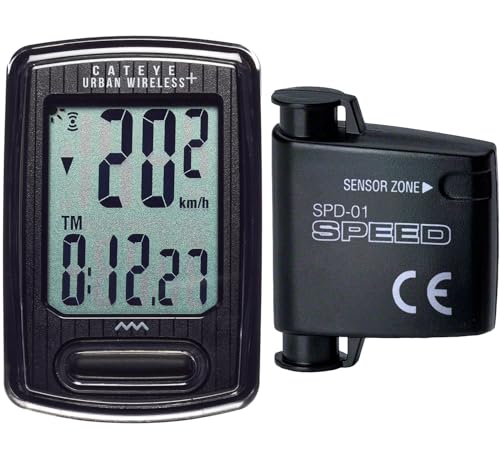
- Backlit display supports rides after sunset
- Tracks core speed, distance, time, and calorie data
- One-year battery life with FlexTight mounting
Best For: Road, MTB, gravel, and commuter riders needing a backlight
Best GPS Battery Life
CYCPLUS G1 Wireless GPS Bike Computer

- GPS route, distance, time, and altitude data
- Automatic backlight with 2-inch FSTN display
- Up to 50 hours of runtime; IPX6 rated
Best For: Long rides and riders wanting a compact GPS computer
Best Simple Sensor Setup
SY Wireless Bicycle Speedometer

- Tracks speed, distance, and riding time
- Auto-wakes when the bike senses vibration
- Two-button interface and tire-size settings
Best For: Casual riders seeking basic cycling statistics
Best Lightweight Display
Wireless GPS Bike Computer with 2.4-Inch Screen

- 50-gram GPS computer with no wheel sensor required
- Shows altitude, gradient, temperature, and ascent
- 2.4-inch screen, IPX7 rating, and USB-C charging
Best For: Hilly routes and riders wanting a larger lightweight display
Simple Stats Pick – CATEYE Velo Wireless
The CATEYE Velo Wireless is a straightforward choice for riders who want essential wireless bike computers data without GPS or complicated setup. It tracks speed, distance, ride time, calories, pace, and more, while automatic stop detection helps keep short stops from skewing your averages.
Best For: Everyday cyclists who want reliable core ride statistics and a simple handlebar-mounted computer.
Pros:
- Displays current, maximum, and average speed plus multiple distance metrics.
- Automatically pauses elapsed time and average-speed calculations when stopped.
- Manual odometer setting preserves mileage after a battery change.
- Includes a secure zip-tie handlebar bracket and IP65 protection.
Cons:
- Uses a proprietary wireless connection rather than GPS or broader sensor connectivity.
- Does not provide navigation or route guidance.
Choose the Velo Wireless if you prefer an uncomplicated computer focused on everyday measurements. Its intuitive tire-size setup and automatic start/stop make it practical for routine rides.
Navigation Upgrade – iGPSPORT BSC500 GPS Bike Computer
The iGPSPORT BSC500 is a feature-rich option among wireless bike computers, pairing a 3.3-inch touchscreen with button controls, multi-satellite positioning, route imports, and voice navigation. It is designed for riders who want turn guidance and training information alongside ride metrics.
Best For: Route-focused cyclists who want a large display, voice prompts, rerouting, and training features.
Pros:
- Supports GPS, BeiDou, GLONASS, Galileo, and QZSS with dual-band positioning.
- Imports routes from the iGPSPORT app, Strava, Komoot, and route files.
- Provides adaptive turn reminders, off-course rerouting, and voice navigation.
- 3.3-inch screen supports touchscreen and button operation and displays up to 12 data points per page.
Cons:
- Its extensive navigation and training features may be more than casual riders need.
- At 107 g, it is heavier than the simpler computers in this roundup.
The BSC500 stands out when navigation and ride planning matter as much as basic speed and distance data. Its loudspeaker, route tools, and climb-training features make it a strong choice for longer or more structured rides.
Large-Display Essential – CATEYE Padrone Wireless
The CATEYE Padrone Wireless keeps wireless bike computers easy to use while giving essential ride data a larger display. Its no-pairing speed sensor, tool-free FlexTight mount, and ClickTec controls are suited to riders who want clear information without GPS complexity.
Best For: Road and recreational cyclists who prioritize a large, readable display and simple operation.
Pros:
- Large display shows current, maximum, and average speed, distance, ride time, and clock.
- Wireless front-wheel speed sensor requires no pairing.
- FlexTight bracket installs and adjusts by hand without tools.
- Automatically stops counting time and averaging speed during stops.
Cons:
- Does not include GPS, navigation, or heart-rate functionality.
- Wireless transmission is specified for front-wheel use only.
The Padrone is a sensible pick for riders who value glanceable basics over advanced connectivity. Its oversized display and ClickTec interface keep ride tracking simple and accessible.
Long-Runtime GPS Pick – GPS Bike Computer
This 2.4-inch GPS bike computer adds elevation-focused information to the standard data set, making it a useful wireless bike computers option for riders tackling climbs and changing terrain. Built-in GPS eliminates the need for a wheel sensor, while the rechargeable battery provides up to 28 hours of riding time.
Best For: Road, mountain, and touring cyclists who want GPS ride tracking, elevation data, and extended battery life.
Pros:
- Tracks speed, distance, ride time, temperature, altitude, gradient, and accumulated ascent.
- Built-in GPS works without a wheel sensor or spoke magnet.
- Up to 28 hours of battery life from a 650mAh rechargeable battery.
- IPX7 waterproofing and automatic backlight support outdoor use.
Cons:
- Provides button controls rather than touchscreen operation.
- The supplied notes do not list route navigation or turn-by-turn guidance.
Choose this model if climbing metrics and endurance are more important than navigation features. Its barometric altitude and gradient measurements give hilly rides more context, while GPS keeps setup sensor-free.
Simple Everyday Pick – CATEYE Urban Wireless Bike Computer
For riders who want dependable wireless bike computers without GPS or app setup, the CATEYE Urban focuses on practical ride data. It tracks speed, distance, time, calories, and more in a compact handlebar-mounted design.
Best For: Everyday commuters, casual riders, and cyclists who prefer straightforward speed and distance tracking.
Pros:
- Tracks current, maximum, and average speed, plus total and trip distance.
- Includes calorie tracking, a pace arrow, elapsed time, and clock.
- FlexTight bracket supports hand-adjusted mounting and repositioning.
- Auto start/stop pauses time and average-speed calculations during stops.
Cons:
- Uses an analog wireless connection rather than GPS, Bluetooth, or ANT+.
- Provides speed data through a speed sensor, without listed cadence or heart-rate support.
Its programmable odometer helps preserve mileage when the battery is changed, while the IPX8 rating adds confidence in wet conditions. Choose it for uncomplicated, low-maintenance ride tracking.
GPS Training Choice – CYCPLUS GPS Wireless Bike Computer M1
The CYCPLUS M1 is a more data-focused option among wireless bike computers, pairing GPS route recording with ANT+ and Bluetooth sensor support. Its 2.9-inch backlit display is designed for readability in sunlight and after dark.
Best For: Riders who want GPS routes, app synchronization, and compatibility with speed, cadence, heart-rate, and power data.
Pros:
- GPS tracks routes and can synchronize ride data with the app and Strava.
- Supports speed, cadence, heart rate, power, altitude, and route data through compatible sensors.
- Includes a switchable speed/cadence sensor and handlebar mount.
- 2.9-inch FSTN LCD automatically adjusts lighting based on sunrise and sunset times.
Cons:
- Rated battery life is up to 60 hours, shorter than the year-long battery life listed for the CATEYE models.
- The included mount is specified for 31.8 mm handlebars.
- Initial setup requires setting the time zone before all functions operate normally.
With a 1200mAh lithium-polymer battery, IPX6 water resistance, and multiple connectivity options, the M1 suits structured training and route review. It is the strongest fit here for cyclists who want more than basic speed and distance readings.
Night-Riding Value – CATEYE Urban Wireless Bike Computer with Backlight
This CATEYE Urban is a practical choice for cyclists who want the simplicity of wireless bike computers with the added convenience of a backlit display. It presents core speed, distance, time, and calorie metrics in a compact format.
Best For: Road, mountain, gravel, and commuter riders who may continue riding after sunset.
Pros:
- Backlit display improves visibility when riding after dark.
- Measures current, maximum, and average speed, total and trip distance, and elapsed time.
- Includes calorie tracking, pace arrow, clock, and auto start/stop.
- One-year battery life and a hand-adjustable FlexTight mount simplify ownership.
Cons:
- Uses analog wireless speed sensing rather than GPS or app connectivity.
- Does not list cadence, heart-rate, or power measurement support.
The programmable odometer preserves accumulated mileage after a battery change, and the IPX8 rating is well suited to wet-weather use. Choose this version over the similar CATEYE option if its backlight is important to your riding routine.
Best GPS Battery Life – CYCPLUS G1 Wireless GPS Bike Computer
The CYCPLUS G1 is a practical choice among wireless bike computers for riders who want GPS-based route and ride data without handlebar cables. Its 2-inch backlit display, IPX6 water resistance, and large rechargeable battery suit regular road and recreational cycling.
Best For: Riders who prioritize long battery life, GPS tracking, and a compact, weather-resistant design.
Pros:
- GPS tracks route, speed-related ride data, distance, time, clock, and altitude.
- Automatic backlight and FSTN display are designed for visibility in daylight and at night.
- Up to 50 hours of battery life with IPX6 water resistance.
- Lightweight 70-gram design with a two-year warranty.
Cons:
- Only a 2-inch screen may feel compact for riders who prefer larger readouts.
- Its listed functions focus on core ride data rather than advanced connectivity features.
Choose the G1 if extended runtime and straightforward GPS data matter more than a larger display or a broader feature set. Automatic sleep mode also helps preserve battery between rides.
Best Simple Sensor Setup – SY Wireless Bicycle Speedometer
The SY bicycle speedometer is one of the simpler wireless bike computers for tracking everyday speed, distance, and riding time. It uses a separate sensor and magnet, offers a two-button interface, and supports common road, mountain, and folding bicycles.
Best For: Casual and fitness-focused cyclists who want basic ride statistics with a straightforward sensor-based setup.
Pros:
- Measures speed, distance, and riding time.
- Auto-wake function responds to bicycle vibration.
- Day and night backlight activates when a button is pressed during listed nighttime hours.
- Small, lightweight design with customizable settings for common tire sizes.
Cons:
- IP54 protection is more limited than the higher waterproof ratings on the GPS models.
- The 1.2-inch LCD is smaller than the displays on the other listed computers.
- May not work with some electric-assist bicycles.
This model makes sense when you need essential cycling statistics rather than GPS mapping or elevation data. Installation is designed to be quick, but sensor and magnet placement must stay within the specified distances.
Best Lightweight Display – Wireless GPS Bike Computer with 2.4-Inch Screen
This wireless GPS bike computer offers a larger 2.4-inch screen while keeping weight to 50 grams. It records core ride metrics without a wheel sensor or spoke magnet and adds altitude, gradient, temperature, and accumulated ascent data for riders who regularly encounter hills or varied routes.
Best For: Commuters, leisure riders, and outdoor cyclists who want a lightweight GPS computer with elevation-focused data.
Pros:
- Built-in GPS displays current, average, and maximum speed plus distance, ride time, and total mileage.
- Provides temperature, altitude, gradient, and accumulated ascent information.
- 2.4-inch LCD with green automatic backlight is designed for easy reading.
- IPX7 water resistance, USB-C charging, auto start/stop, and up to 28 hours of runtime.
Cons:
- Its 28-hour runtime is shorter than the CYCPLUS G1’s listed battery life.
- The supplied notes do not list navigation or route-mapping functions.
Consider this computer if screen size, low weight, and hill-related data are high priorities. Its standard mount and included mounting hardware make it a useful option for everyday riding, while IPX7 protection adds confidence in wet conditions.
How We Picked the Best Wireless Bike Computers
We focused on the features that matter most during real rides: accurate speed and distance tracking, readable displays, dependable wireless or GPS connectivity, practical battery life, weather resistance, and mounting convenience. We also considered whether each model is better suited to casual cycling, structured training, navigation, or mixed use.
Product specifications can vary by configuration and firmware, so check the manufacturer’s current details before purchase. GPS accuracy may also change with tree cover, buildings, terrain, and satellite conditions.
Quick Comparison
| Type | Best For | Typical Strength | Potential Trade-Off |
|---|---|---|---|
| Basic wireless computer | Commuting and casual rides | Simple setup and easy-to-read ride data | Limited navigation and advanced metrics |
| GPS computer | Training, touring, and route riding | Speed, route, elevation, and ride recording | More setup and battery management |
| GPS model with navigation | Exploring unfamiliar routes | Maps, turn guidance, and route support | Usually costs more and requires charging |
| Large-display computer | Riders who value visibility | At-a-glance speed and distance readings | Can be bulkier on the handlebar |
Key Buying Factors for Wireless Bike Computers
Wireless Sensors Versus GPS
Traditional wireless computers often use a wheel or crank sensor and are straightforward for tracking speed, distance, and cadence when supported. GPS computers calculate location from satellites, reducing sensor hardware and adding route, elevation, and mapping features. Choose a sensor-based model for simplicity; choose GPS when recorded routes and navigation matter.
Display and Controls
A larger screen is easier to read while riding, especially for speed or distance checks. Touchscreens can make maps and menus more convenient, but physical buttons may be easier to operate with gloves or in wet conditions. Look for a layout that shows the metrics you actually use rather than prioritizing the largest possible display.
Battery Life and Charging
For short daily rides, nearly any listed battery capacity may be sufficient. Long-distance riders should compare claimed runtime, charging method, standby behavior, and whether navigation significantly reduces endurance. A low-battery warning and accessible charging port are useful practical details.
Weather Resistance and Installation
Water resistance helps protect against rain and road spray, but ratings are not always identical in practice. Confirm the stated IP rating and follow the manufacturer’s limits. Also check that the included mount fits your handlebar and that sensor installation, pairing, and wheel-size calibration are manageable.
Who Should Buy Which Wireless Bike Computers?
- For simple commuting: Choose a basic wireless model with a clear display, reliable mounting, and speed and odometer functions.
- For training: Look for GPS recording, elevation data, longer battery life, and compatibility with cadence or heart-rate accessories if needed.
- For touring and exploration: Prioritize navigation, route support, weather resistance, and enough runtime for your longest planned rides.
- For older riders or anyone who values visibility: Select a large, high-contrast display with uncomplicated controls.
- For lightweight setups: Compare overall computer and mount weight, especially if you already carry lights, a phone, or other handlebar accessories.
The right wireless bike computer should match your riding habits rather than simply offer the longest feature list. Start with the data you need most, then weigh navigation, battery life, screen size, and installation against your budget.