Low ceilings can make a full-size home gym setup difficult, but the right pull-up bar can still support effective upper-body training without wasting valuable overhead space. This roundup compares compact doorway bars, joist and ceiling mounts, and freestanding power towers.
We focused on installation requirements, usable height, weight capacity, grip options, stability, and overall space demands so you can choose a pull-up bar that fits both your room and your training style.
Best 10 Pull Up Bar for Low Ceilings Picks for 2026
Best Joist-Mount Option
Shnlie 42-Inch Joist-Mounted Pull-Up Bar

- Supports up to 440 pounds
- Mounts to wood joists, beams, or rafters
- Includes foam grips and installation guidance
Best For: Wood-joist home gyms with limited floor space
Best No-Drill Choice
Sportneer Adjustable Doorway Pull-Up Bar

- Adjusts from 29.5 to 37 inches
- Installs without drilling
- Manual maximum load is 297 pounds
Best For: Compatible solid wood doorways and rental spaces
Best Adjustable Ceiling Bar
SELEWARE Multi-Grip Ceiling Pull-Up Bar

- Offers four height adjustments
- Includes five grip positions and accessory rings
- Supports up to 400 pounds
Best For: Multi-exercise home gyms with secure ceiling or joist mounting
Best Freestanding Alternative

- Adjusts from 71.4 to 84.9 inches
- Supports pull-ups, dips, push-ups, and knee raises
- Uses an extended H-shaped stabilizing base
Best For: Low-ceiling rooms where drilling is not practical
Best Fold-Away Doorway Option

- No-drill doorway installation
- Folds away for storage
- 440-pound capacity
Best For: Renters and compact home gyms
Best Adjustable Ceiling Mount

- 25.8- to 41-inch height adjustment
- 500-pound weight rating
- Eight-hole stability design
Best For: Heavy-duty low-ceiling home gyms
Best Joist-Mounted Design
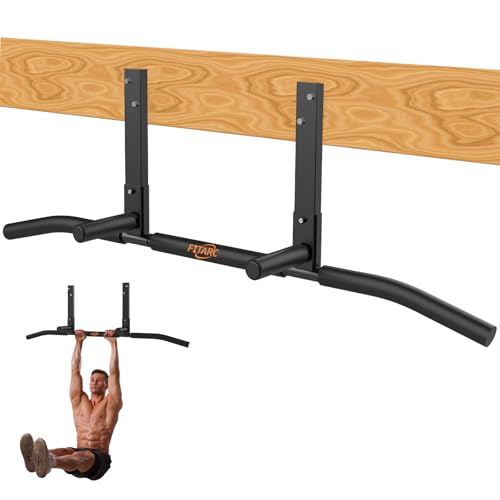
- Compact 12.9-inch height
- 440-pound capacity
- Four padded grip positions
Best For: Basement and garage gyms with wooden joists
Best Low-Ceiling Doorway Option
Multi-Grip Foldable Pull-Up Bar

- Fits many narrow or corner doorways
- Folds away for convenient storage
- Includes straps and multiple grip options
Best For: Space-conscious users with a compatible doorway
Best Adjustable Power Tower
Sportsroyals Free-Standing Pull-Up Station

- Adjusts across eight height levels
- Offers 10 full-body strength exercises
- Uses a sturdy steel frame and wide base
Best For: Families needing adjustable, full-body home training
Best Family Height Range
SogesPower Adjustable Power Tower

- Offers 10 height-adjustment levels
- Supports six bodyweight exercises
- Uses a wide H-shaped base with suction cups
Best For: Families sharing a versatile free-standing workout station
Best Joist-Mount Option – Shnlie 42-Inch Joist-Mounted Pull-Up Bar
For shoppers seeking a pull up bar for low ceilings, the Shnlie is a practical joist-, beam-, or rafter-mounted choice. Its 13-inch height and 42-inch width provide a sturdy training station, while the steel construction supports up to 440 pounds.
Best For: Home gyms with an accessible wood joist, beam, or rafter and limited floor space.
Pros:
- Heavy-duty alloy-steel construction with a stated 440-pound capacity.
- Designed for installation on wood joists, beams, or rafters.
- Six foam grip pads and a protective coating support comfortable, durable use.
- Includes installation accessories, instructions, and video guidance.
Cons:
- Requires drilling and a solid wood mounting surface.
- Its 42-inch width and 13-inch height should be checked against the available space.
This is a strong fit when overhead mounting is possible and you want a compact, permanently installed bar. Confirm the joist location and clearance before installation.
Best No-Drill Choice – Sportneer Adjustable Doorway Pull-Up Bar
The Sportneer is a convenient pull up bar for low ceilings when a suitable doorway is available. It adjusts from 29.5 to 37 inches and installs without drilling, but it is intended for solid wood door frames and has a manual maximum load of 297 pounds.
Best For: Renters or home users who want removable pull-up equipment for a compatible solid wood doorway.
Pros:
- No-drill installation helps avoid permanent mounting holes.
- Adjusts between 29.5 and 37 inches for different doorway widths.
- Dual gear locks, large PVC pads, and four metal fixed points improve stability.
- Integrated anti-slip handle supports multiple grip and exercise options.
Cons:
- Only suitable for solid wood door frames; painted or plastered walls are not recommended.
- The doorway must measure 29.5 to 37 inches and be wider than the end pads.
- The instructions specify a 297-pound maximum load despite higher testing figures.
This bar is the most flexible option for temporary use, provided the doorway meets every fit and construction requirement. Measure carefully and follow the locking direction during setup.
Best Adjustable Ceiling Bar – SELEWARE Multi-Grip Ceiling Pull-Up Bar
The SELEWARE offers a versatile pull up bar for low ceilings with four height settings and several grip positions. It mounts to a ceiling, wall, or joist and supports up to 400 pounds, making it useful for compact spaces where adjustable positioning matters.
Best For: Users who want adjustable height, varied grips, and attachment points for suspension or resistance accessories.
Pros:
- Four height settings accommodate different users and exercises.
- Five grip positions include a specialized ball finger grip.
- Heavy-duty steel construction and a four-hole design support secure mounting.
- Includes rings for suspension straps or yoga bands and hardware for wood and concrete.
Cons:
- Requires drilling and a suitable structural mounting surface.
- Installation compatibility depends on stud spacing of 12 or 24 inches.
- Its stated maximum weight recommendation is 400 pounds.
Choose this model when a fixed installation is acceptable and you want more training variety than a basic straight bar provides. Verify the mounting structure and available ceiling clearance first.
Best Freestanding Alternative – Pooboo Adjustable Power Tower
If ceiling or doorway mounting is not practical, the Pooboo Power Tower is a freestanding alternative to a pull up bar for low ceilings. Its pull-up height adjusts from 71.4 to 84.9 inches, and the station also supports dips, push-ups, and vertical knee raises.
Best For: Home gyms that need a multifunctional, freestanding station instead of a drilled overhead bar.
Pros:
- Eleven height levels accommodate different users and ceiling conditions.
- Combines pull-ups, chin-ups, dips, push-ups, and knee raises.
- Extended H-shaped base, non-slip feet, and safety locknuts improve stability.
- Includes a supportive backrest and bonus resistance bands.
Cons:
- Requires approximately 41.49 by 43.5 inches of floor space.
- Assembly is estimated at 30 to 60 minutes, with two people recommended.
- The maximum listed height is 84.9 inches, so ceiling clearance still needs checking.
This is a useful choice when you want a full-body station without drilling into a ceiling, wall, or doorway. Measure both the footprint and highest adjustment before purchasing.
Best Fold-Away Doorway Option – Space-Saving Pull-Up Bar
If you need a pull up bar for low ceilings but prefer not to drill into the ceiling, this foldable doorway model offers a portable alternative. It hooks onto compatible doorframes without screws and folds away for storage, while its raised bar and included suspension straps add workout flexibility.
Best For: Renters and home users who want a no-drill, space-saving doorway setup.
Pros:
- No assembly or screwing required; hooks directly onto the doorframe.
- Foldable design saves storage space, with suspension straps included.
- Supports up to 440 pounds and uses padded hooks to help protect the frame.
- Fits door widths from 27.56 to 36.22 inches and includes multiple grip positions.
Cons:
- Requires a compatible doorframe within the listed width and depth limits.
- Its doorway mounting design may not suit users seeking a permanent ceiling station.
This is a practical choice when low overhead clearance and easy storage matter most. Verify your doorframe dimensions before buying, especially if your opening is unusually narrow or shallow.
Best Adjustable Ceiling Mount – Kipika Adjustable Pull-Up Bar
For shoppers specifically seeking a pull up bar for low ceilings, the Kipika stands out for its adjustable mounting height. The ceiling-mounted bar adjusts from 25.8 to 41 inches and uses an eight-hole design, making it easier to tailor the station to your available space and preferred range of motion.
Best For: Home gym users who want a heavy-duty ceiling bar with adjustable height.
Pros:
- Adjusts from 25.8 to 41 inches for different ceiling heights and preferences.
- Rated to support up to 500 pounds with an eight-hole stability design.
- Heavy steel construction includes a rust- and corrosion-resistant electrophoretic coating.
- Includes mounting hardware for installation on a standard joist.
Cons:
- Ceiling installation requires a suitable standard joist.
- Its 48-inch-wide structure needs adequate overhead and lateral space.
The adjustable height makes this one of the more adaptable choices for lower ceilings, while the 500-pound rating suits demanding strength routines. Measure your ceiling and confirm joist placement before installation.
Best Joist-Mounted Design – Compact Home Gym Pull-Up Bar
This joist-mounted bar is a strong candidate for a pull up bar for low ceilings when you have exposed or accessible wooden beams in a basement or garage. Its compact 12.9-inch height keeps the structure relatively low, while the dual-support steel design provides a stable base for pull-ups, chin-ups, and hanging leg raises.
Best For: Basement and garage gyms with suitable wooden joists or beams.
Pros:
- Compact joist-mounted structure helps conserve overhead space.
- Heavy-duty steel construction supports up to 440 pounds.
- Four padded, nonslip grip positions help accommodate different exercises.
- Installation instructions and videos are included.
Cons:
- Installation is intended for wooden beams and requires a suitable mounting surface.
- It is not height-adjustable like the Kipika ceiling model.
Choose this model when a low-profile, permanent station fits your basement or garage layout. Its compact form is useful for lower overhead areas, but careful joist selection is essential for a secure installation.
Best Low-Ceiling Doorway Option – Multi-Grip Foldable Pull-Up Bar
If you need a pull up bar for low ceilings, this doorway model is a practical choice because it mounts inside the frame rather than taking up floor-to-ceiling space. Its foldable design stores quickly, while the compact 21.65-inch hook spacing is intended to fit many narrower or corner doorways.
Best For: Home users who want a versatile, space-saving doorway pull-up bar for rooms with limited ceiling height.
Pros:
- Fits door widths from 21.65 to 36.22 inches and accepts trim up to 3.54 inches high.
- Foldable construction and included suspension straps add workout versatility.
- Ergonomic angled grips, soft nonslip foam, and multiple grip positions support varied exercises.
- Rated for up to 440 pounds and includes premium silicone door protectors.
Cons:
- Requires a sound, compatible doorframe and is not suitable for hollow plasterboard walls.
- Users must measure the inside of the doorframe before ordering.
For low-ceiling spaces, the doorway-mounted format is the main advantage. Verify the frame dimensions and condition carefully, then fold it away when you need to reclaim the doorway.
Best Adjustable Power Tower – Sportsroyals Free-Standing Pull-Up Station
For shoppers seeking a pull up bar for low ceilings without drilling into a doorway, this free-standing power tower adjusts from 57.09 to 83.07 inches. The height range can work in some lower rooms, but measure your available ceiling clearance and account for workout movement before buying.
Best For: Families wanting an adjustable, multi-exercise station that can fit under relatively low ceilings.
Pros:
- Eight height settings span 57.09 to 83.07 inches for different users and rooms.
- Supports pull-ups, dips, inverted rows, leg raises, and push-ups.
- Commercial steel construction and a Π-shaped base support a stated 360-pound capacity.
- Ergonomic armrests, padded backrest, and nonslip grips improve workout comfort.
Cons:
- The tallest settings may not suit genuinely low ceilings.
- Its floor-standing design requires more space than a doorway-mounted bar.
This tower is more versatile than a basic pull-up bar and offers useful height adjustability. It is a strong candidate for low-ceiling rooms only after confirming both the selected height and overhead clearance.
Best Family Height Range – SogesPower Adjustable Power Tower
This SogesPower station is worth considering as a pull up bar for low ceilings because its height adjusts through multiple levels, with a listed range beginning around 65 inches. Its free-standing design avoids permanent mounting, though the broad base requires dedicated floor space and a level surface.
Best For: Households that want a height-adjustable station for pull-ups, dips, and other bodyweight exercises.
Pros:
- Ten height settings accommodate different adult users and a lower setting for children.
- Supports pull-ups, chin-ups, dips, knee raises, push-ups, and leg pressing.
- H-shaped base, steel construction, and larger suction cups are designed for stability.
- Rated to support up to 330 pounds.
Cons:
- The 32.3-by-29.5-inch footprint takes more floor space than a doorway bar.
- Suction cups work best on flat concrete floors rather than carpets.
- Confirm the actual height setting and ceiling clearance before overhead exercises.
Its wide adjustment range makes it more adaptable than a fixed-height tower, especially for shared family use. For a low room, choose a lower setting and make sure the floor provides a stable base.
How We Picked the Best Pull Up Bar for Low Ceilings
We evaluated these 10 options based on the factors that matter most in rooms with limited overhead clearance. The comparison considers mounting method, adjustability, footprint, stated weight capacity, grip variety, installation complexity, and whether the design supports more than standard pull-ups. We also separated products that require structural mounting from no-drill doorway models and freestanding stations, since each category suits a different home setup.
Always verify the product’s dimensions against your available ceiling and floor space. Rated capacities are not interchangeable with recommendations for dynamic movements, kipping, or added weight unless the manufacturer specifically supports those uses.
Quick Comparison
- Best for permanent overhead mounting: Joist- and ceiling-mounted bars provide a clean setup when securely attached to suitable framing.
- Best for renters: No-drill doorway bars are easier to install and remove, but they depend heavily on compatible door frames.
- Best for multiple exercises: Power towers add dip stations and other workout positions, though they require more floor space.
- Best for grip variety: Multi-grip bars offer several hand positions for pull-ups, chin-ups, and neutral-grip work.
Key Buying Factors for a Pull-Up Bar for Low Ceilings
Available Height and Clearance
Measure from the floor to the ceiling, then account for the bar’s mounting height and your head, shoulders, and knees during each movement. A lower bar may work well for bent-knee pull-ups, while taller users may need a ceiling or joist mount with adjustable positioning.
Mounting Surface and Installation
Joist and ceiling models must attach to sound structural members, not drywall alone. Check joist spacing, included hardware, and whether the mounting location allows enough room behind and beside the bar. Doorway models are simpler, but the frame must be wide and strong enough for the stated range.
Stability, Capacity, and Exercise Type
Look for a generous weight rating, secure locking or fastening systems, and minimal movement under load. If you plan to add resistance bands, use a weighted vest, or perform dips, confirm that the design is intended for those activities. Freestanding towers should have a broad, stable base and enough surrounding clearance.
Grip Design and Storage
Foam or textured grips can improve comfort, while multiple handles support varied training. Foldable or removable doorway bars are useful when the room serves several purposes, but frequent setup changes should not compromise secure installation.
Who Should Buy Which Pull Up Bar for Low Ceilings?
Choose a joist- or ceiling-mounted bar if you own the space, can access solid framing, and want the most permanent, low-footprint solution. A no-drill doorway bar is better for renters or users who need quick removal, provided the door frame is compatible. Select a power tower if you want pull-ups plus dips and other bodyweight exercises and have sufficient floor area. For shared households or varied training routines, a multi-grip model offers more hand positions, while an adjustable-height bar can make a low-ceiling setup more comfortable for users of different heights.