The right indoor trainer can make triathlon training more consistent when weather, traffic, or limited daylight gets in the way. The models in this roundup cover simple magnetic stands, direct-drive units, and advanced smart trainers for structured workouts.
We focused on resistance control, connectivity, power accuracy, riding feel, compatibility, and practical setup so you can choose a trainer that matches your training goals, bike, and budget.
Best 10 Bike Trainers for Triathlons Picks for 2026
Best All-Around Smart Trainer

- Smooth road-like resistance for structured training
- Built-in Wi-Fi for pairing and updates
- 1,800W output with 16% grade simulation
Best For: Triathletes seeking a dependable connected trainer
Best Realistic Ride Feel

- Motion plates add multidirectional movement
- Simulates surfaces and climbs up to 25%
- Measures power with accuracy within 1%
Best For: Triathletes wanting immersive premium simulation
Best Budget Option

- Eight levels of magnetic resistance
- Folding 8 kg frame stores easily
- Fits road, gravel, MTB, and city bikes
Best For: Affordable foundational indoor training
Best Value Smart Trainer

- 2,000W output with ±2% power accuracy
- ANT+ and BLE support for training apps
- Simulates gradients up to 18%
Best For: Connected virtual training at a value-focused price
Portable Magnetic Trainer
Foldable 6-Level Indoor Bike Stand
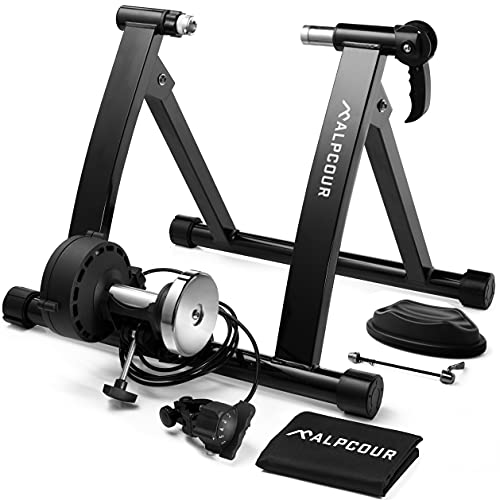
- Six handlebar-controlled resistance levels
- Foldable stainless-steel frame with carry bag
- Fits most 26- to 28-inch and 700c wheels
Best For: Portable, manually adjustable indoor training
Smart Direct-Drive Trainer
ThinkRider XXPRO 2500W Smart Trainer

- Up to 2,500 watts and 25% gradient simulation
- Bluetooth and ANT+ connectivity
- Direct drive with claimed ±1% accuracy
Best For: Connected, high-intensity indoor workouts
Heavy-Duty Magnetic Trainer
6-Level Folding Bike Trainer Stand

- 330-pound stated load capacity
- Fits 26- to 29-inch and 700c wheels
- Six handlebar-adjustable resistance levels
Best For: Simple indoor training with broad wheel compatibility
High-Power Terrain Trainer

- 2,200W output with ±1% power accuracy
- Simulates gradients up to 19%
- BLE/ANT+ app connectivity
Best For: Triathletes training for demanding climbs and structured indoor workouts
Pro-Level Smart Connectivity

- 2,100W output with ±1% accuracy
- WiFi, Bluetooth, and ANT+ connectivity
- Includes Zwift Cog and Zwift Click
Best For: Triathletes wanting an easy Zwift-ready direct-drive setup
Quiet High-Gradient Trainer

- 2,200W output with ±1% accuracy
- Simulates gradients up to 20%
- Noise-reduction design operates under 55 dB
Best For: Triathletes needing quiet, hill-focused indoor sessions
Best All-Around Smart Trainer – Wahoo KICKR CORE 2
For athletes comparing bike trainers for triathlons, the Wahoo KICKR CORE 2 offers a strong balance of realistic ride feel, connectivity, and structured-workout capability. Its direct-drive design, built-in Wi-Fi, 1,800-watt maximum output, and 16% simulated grade make it well suited to consistent indoor training.
Best For: Triathletes who want a dependable smart trainer for structured sessions, virtual riding, and hard efforts.
Pros:
- Smooth, road-like resistance designed for hard efforts and structured training.
- Built-in Wi-Fi supports faster pairing and automatic updates.
- Includes an 11-speed cassette and fits 8- to 13-speed drivetrains.
- Provides up to 1,800 watts, 16% grade simulation, and ±2% power accuracy.
Cons:
- At 13.6 kg, it is not especially lightweight for frequent moving.
- The included cassette is 11-speed, so other drivetrain setups may require compatibility checks.
The KICKR CORE 2 is a practical centerpiece for triathlon training, especially when repeatable power work and convenient app connectivity matter more than portability.
Best Realistic Ride Feel – Garmin TacX NEO 3M
Garmin TacX NEO 3M Smart Trainer, Multidirectional Movement, Realistic Ride Fee
Check Price On AmazonAmong bike trainers for triathlons, the Garmin TacX NEO 3M stands out for its integrated motion plates and detailed ride simulation. It can reproduce road surfaces, simulate climbs up to 25%, and measure power, speed, and cadence with improved accuracy within 1%.
Best For: Triathletes who prioritize immersive road simulation, multidirectional movement, and high-end virtual training.
Pros:
- Integrated motion plates can be toggled on or off for a more realistic ride.
- Simulates surfaces such as cobblestone and gravel through compatible training apps.
- Supports simulated inclines up to 25% and descents.
- Pre-installed 11-speed cassette, no calibration requirement, and compatibility with Zwift and TrainerRoad.
Cons:
- Its 52-pound weight makes it less convenient to store or transport.
- Some premium training content and features require app subscriptions.
- Its extensive feature set may be more than casual indoor riders need.
The NEO 3M is a premium choice for athletes who want indoor sessions to feel closer to outdoor riding, including movement, changing surfaces, and steep virtual climbs.
Best Budget Option – Elite Novo Force
The Elite Novo Force is a straightforward option for athletes looking for bike trainers for triathlons without requiring a full smart-trainer setup. Its magnetic resistance offers eight levels, and the folding 8 kg frame works with road, gravel, mountain, and city bikes.
Best For: Budget-conscious triathletes who need basic indoor endurance and strength training with broad bike compatibility.
Pros:
- Eight resistance levels provide adjustable training intensity.
- Lightweight folding frame supports easier storage.
- Compatible with road, gravel, mountain, and city bikes.
- Can pair with a Misuro B+ sensor for selected training platforms and data tracking.
Cons:
- It is a wheel-on magnetic trainer rather than a direct-drive smart trainer.
- Maximum stated output is 690 watts at 40 km/h, limiting very high-power work.
- The Misuro B+ sensor is needed for app integration.
The Novo Force makes sense for foundational indoor riding and occasional workouts, but athletes focused on precise power-based triathlon sessions may prefer a connected direct-drive model.
Best Value Smart Trainer – ThinkRider X2Max
The ThinkRider X2Max is a capable smart option for athletes comparing bike trainers for triathlons on a value-oriented budget. It supports ANT+ and Bluetooth, works with mainstream cycling software such as Zwift, and automatically adjusts resistance to simulate gradients up to 18%.
Best For: Triathletes who want connected virtual riding, quiet operation, and substantial climbing simulation without moving to a higher-priced premium trainer.
Pros:
- Supports BLE and ANT+ for broad device connectivity.
- Delivers up to 2,000 watts with stated power accuracy of ±2%.
- Automatically matches virtual route gradients up to 18%.
- Reported noise is about 58 dB at 30 km/h, with an I-beam structure for stability.
Cons:
- The cassette is not included.
- The stated 18% gradient simulation is below the Garmin TacX NEO 3M’s 25% capability.
- Compatibility and setup may require selecting the appropriate ANT+ or Bluetooth connection.
The X2Max offers a useful mix of power, connectivity, and virtual climbing for structured indoor training, provided you account for the separate cassette requirement.
Portable Magnetic Trainer – Foldable 6-Level Indoor Bike Stand
For triathletes seeking practical bike trainers for triathlons, this portable magnetic stand offers a straightforward way to keep riding indoors. It fits most 26- to 28-inch and 700c wheels, uses six handlebar-controlled resistance levels, and folds into its included carry bag for storage or travel.
Best For: Road and mountain-bike riders who want portable, adjustable indoor training without a smart-trainer setup.
Pros:
- Six resistance settings help simulate flats, climbs, and intervals.
- Foldable stainless-steel frame includes a storage and travel bag.
- Wide base, low stance, riser block, and rubber pads support stability.
- Quick lever setup requires no tools.
Cons:
- Magnetic resistance is manually adjusted rather than app-controlled.
- Compatibility is listed for most 26- to 28-inch and 700c wheels, so other sizes may not fit.
- Rough mountain-bike tires may still produce indoor noise.
This is a sensible choice for consistent indoor mileage and basic interval work, especially when portability matters more than virtual-training features.
Smart Direct-Drive Trainer – ThinkRider XXPRO 2500W Smart Trainer
For structured bike trainers for triathlons, the ThinkRider XXPRO is the most feature-rich option here. Its direct-drive motor system supports claimed data accuracy of ±1%, up to 2,500 watts, a simulated 25% gradient, and Bluetooth or ANT+ connectivity for compatible training platforms and devices.
Best For: Triathletes who want connected indoor workouts, high resistance capacity, and uphill and downhill simulation.
Pros:
- Direct motor drive avoids tire contact and requires no calibration, according to the supplied notes.
- Supports Bluetooth, ANT+, bike GPS, PC, and Zwift connectivity.
- Simulates gradients up to 25% and downhill sections.
- Can generate its own electricity or use the included power adapter.
Cons:
- Listed load capacity is 242 pounds.
- Its advanced electronics and connectivity may be unnecessary for simple riding sessions.
- Road-bike compatibility is the only bike type specified in the supplied details.
The XXPRO is the strongest fit for data-focused training and virtual courses, provided your bike and training setup match its listed compatibility.
Heavy-Duty Magnetic Trainer – 6-Level Folding Bike Trainer Stand
This magnetic stand is a basic, budget-minded option among bike trainers for triathlons. Its pyramid-style frame is rated for up to 330 pounds, accepts 26- to 29-inch and 700c wheels, and provides six handlebar-adjustable resistance levels for indoor riding when weather or traffic disrupts outdoor training.
Best For: Riders who prioritize broad wheel compatibility, high stated load capacity, and simple indoor exercise.
Pros:
- 330-pound stated load capacity exceeds the other conventional stand listed here.
- Works with 26- to 29-inch and 700c wheels.
- Six resistance levels are adjusted from the handlebars.
- Folding design, quick clamp, and included riser block simplify setup and storage.
Cons:
- It is a conventional magnetic trainer without smart connectivity.
- Rough MTB tires can be loud and increase vibration indoors.
- The supplied details list a plastic frame material despite an iron material listing, so construction specifications are somewhat unclear.
This trainer makes sense for dependable, no-frills indoor sessions, particularly for riders using larger wheels or wanting a generous stated weight limit.
High-Power Terrain Trainer – CYCPLUS R200
The CYCPLUS R200 is a strong option among bike trainers for triathlons when you want accurate power data and realistic gradient simulation for structured indoor workouts. Its 2,200W output, up to 19% incline simulation, and BLE/ANT+ connectivity support demanding sessions with compatible training apps.
Best For: Triathletes who want high-power virtual climbing, app-based workouts, and flexible connectivity.
Pros:
- Brushless motor delivers up to 2,200W with power accuracy rated at ±1%.
- Simulates uphill and downhill gradients up to 19% through compatible riding software.
- Supports BLE and ANT+ connections with apps including Zwift and MyWhoosh.
- Built-in cooling fan helps maintain performance during extended sessions.
Cons:
- Cassette is not included.
- Virtual shifting requires the separately sold CYCPLUS BC2 Shifter.
- Virtual shifting is not compatible with ERG mode.
With its high power ceiling, precise power measurement, and broad app connectivity, the R200 is well suited to serious indoor triathlon preparation. Account for the additional cassette and optional shifter when planning your setup.
Pro-Level Smart Connectivity – Elite Avanti Smart Trainer
The Elite Avanti is a direct-drive choice among bike trainers for triathlons, combining ±1% power accuracy with WiFi, Bluetooth, and ANT+ connectivity. Its included Zwift Cog and Click make it especially convenient for virtual training, while the 2,100W capacity and 18% climb simulation support intense sessions.
Best For: Triathletes seeking a ready-to-use Zwift setup with precise power tracking and multiple connection options.
Pros:
- Includes a pre-installed Zwift Cog and Zwift Click with 24 virtual gears.
- Integrated power meter provides ±1% accuracy and up to 2,100W output.
- WiFi, Bluetooth, and ANT+ support a wide range of training apps and devices.
- Works with 8- to 12-speed drivetrains and includes QR and thru-axle adapters.
Cons:
- The Zwift-focused setup may add features you do not need if you use another platform.
- Maximum load capacity is listed as 110 kg.
The Avanti stands out for easy setup and broad wireless compatibility, making it a practical choice for athletes who move between apps or devices. Its included virtual-shifting hardware also reduces the need for extra accessories when starting Zwift training.
Quiet High-Gradient Trainer – CYCPLUS T2H Smart Trainer
The CYCPLUS T2H is a compelling option among bike trainers for triathlons when quiet operation matters in a home training space. It combines a 2,200W brushless motor, up to 20% gradient simulation, ±1% power accuracy, and dual BLE/ANT+ connectivity for demanding virtual workouts.
Best For: Triathletes who need powerful climbing simulation and low-noise indoor training.
Pros:
- Provides up to 2,200W of power with ±1% power-meter accuracy.
- Simulates inclines up to 20% through compatible riding software.
- Dual BLE and ANT+ support connects with apps such as Zwift.
- Triple-layer noise reduction keeps operation under 55 dB.
Cons:
- Virtual shifting requires the separately sold CYCPLUS BC2 Shifter.
- Virtual shifting is not compatible with ERG mode.
- The supplied notes do not specify included cassette or axle hardware.
The T2H is a strong fit for early-morning or shared-space training because its specified noise level is under 55 dB. Its 20% gradient capability also gives hill-focused triathlon workouts plenty of resistance range, provided the optional shifting requirements suit your setup.
How We Picked the Best Bike Trainers for Triathlons
We evaluated these Bike Trainers for Triathlons by looking at the features that matter during base miles, interval sessions, race-specific efforts, and recovery rides. The selection includes wheel-on models for affordability and portability, plus direct-drive smart trainers that generally offer better stability, quieter operation, and more precise resistance control.
We also considered stated maximum power, simulated gradient, connectivity options, power accuracy, cassette or drivetrain requirements, portability, and compatibility with popular training platforms such as Zwift. Because product specifications and included accessories can vary by bundle, verify the current listing before ordering.
Quick Comparison
- Best overall training versatility: Look for a direct-drive smart trainer with accurate power measurement, broad connectivity, and automatic resistance control.
- Best for immersive simulation: Choose a high-end model with multidirectional movement or a stronger climbing simulation.
- Best for smaller budgets: A magnetic wheel-on trainer can provide reliable indoor riding without requiring a cassette or electronic setup.
- Best for portability: Foldable wheel-on stands are easier to store and transport, though they typically provide less realistic resistance changes.
- Best for demanding intervals: Prioritize a high maximum wattage, stable frame, accurate power data, and responsive wireless control.
Key Buying Factors for Bike Trainers for Triathlons
Trainer Type and Bike Compatibility
Wheel-on trainers clamp onto the rear axle and use the existing rear tire, making them relatively simple and affordable. Direct-drive trainers remove the rear wheel and use a cassette, which can improve stability and reduce tire noise. Check axle standards, cassette compatibility, drivetrain speeds, and whether an adapter is required.
Power Accuracy and Resistance Control
For structured triathlon workouts, dependable power data is more useful than an impressive wattage claim alone. Smart trainers can automatically match workout targets, while basic magnetic trainers rely on manual resistance settings or bike gearing. A higher simulated gradient can be helpful for hill training, but it is not essential for every athlete.
Connectivity, Noise, and Movement
ANT+ and Bluetooth support make it easier to connect a trainer to a cycling computer, phone, tablet, or training platform. Wi-Fi can improve connection stability on compatible models. Consider noise levels if you train near bedrooms or shared living spaces, and decide whether side-to-side or multidirectional movement is worth the added cost.
Who Should Buy Which Bike Trainers for Triathlons?
Choose a basic magnetic trainer if you need an inexpensive option for occasional rides, warmups, or winter maintenance. Choose a midrange smart trainer if you regularly follow power-based workouts and want automatic resistance changes. Choose a premium smart trainer if you train frequently, value realistic ride feel and low noise, or need highly consistent data for long-term performance tracking.