A ceiling-mounted pull-up bar can turn unused overhead space into a practical strength-training station for pull-ups, chin-ups, hanging work, and accessories. The right model should match your ceiling structure, available clearance, preferred grip positions, and training goals.
We compared 10 options ranging from compact joist-mounted bars to adjustable multi-grip systems with accessory support. Use the guide below to narrow your choices before checking each product’s specifications, included hardware, and installation requirements.
Best 10 Ceiling Mounted Pull Up Bars Picks for 2026
Flexible Joist Fit
Ultimate Body Press Reversible-Riser Pull-Up Bar

- Reversible risers fit 16- or 24-inch joist layouts
- Four angled grip positions
- 300-pound capacity with 10-year limited warranty
Best For: Adaptable home-gym installations with varied grip training
Adjustable Training Hub
Kipika 32-Inch Ceiling Pull-Up Bar

- Four height settings and an adjustable bar angle
- 400-pound maximum weight recommendation
- Hooks for straps, ropes, bands, or a punching bag
Best For: Versatile home gyms combining pull-ups with accessory training
Wide 8-Foot Ceiling Fit
Ultimate Body Press 48-Inch Straight Bar
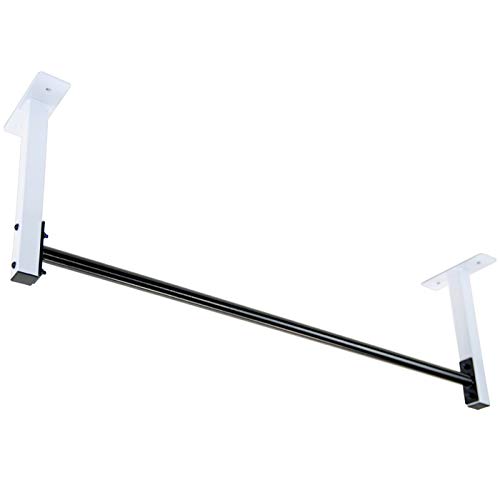
- 48-inch straight bar for generous grip spacing
- Designed for 8-foot ceilings with 14-inch risers
- 450-pound capacity and through-bolted risers
Best For: Spacious pull-up training in rooms with 8-foot ceilings
Maximum Load Capacity
Gronk Fitness Multi-Grip Ceiling Bar

- 800-pound maximum weight recommendation
- Multi-grip monkey-style design
- Reversible, powder-coated frame with residential lifetime warranty
Best For: Heavy-duty home bodybuilding and powerlifting workouts
Most Versatile
Adjustable Ball-Grip Ceiling Pull-Up Bar

- Five grip positions, including a ball finger grip
- Four height settings for customized training
- 400-pound capacity with accessory rings
Best For: Versatile home-gym and grip-strength workouts
Best for Wide-Grip Training

- 42-inch width for a broad training position
- Four non-slip grip configurations
- 350-pound capacity with two height settings
Best For: Wide-grip home-gym and CrossFit training
Best Mounting Flexibility
Reversible-Riser Heavy-Duty Bar

- Risers support ceiling, beam, joist, wall, and doorway mounting
- 400-pound maximum weight recommendation
- Padded grips and lifetime warranty included
Best For: Flexible installations across home workout spaces
Best Adjustable Multi-Grip Pick
Kipika 48-Inch Ceiling Pull-Up Bar

- Five grip styles for varied upper-body workouts
- Adjusts 18 to 26 inches from the mounting surface
- 300-pound capacity with rust-resistant metal coating
Best For: Home gyms needing grip variety and adjustable positioning
Best Joist-Mount Value
Shnlie 42-Inch Joist-Mounted Pull-Up Bar

- 440-pound recommended weight capacity
- Six foam-padded grip sections
- Includes hardware, instructions, and installation videos
Best For: Wood-beam or joist installations requiring strong support
Best High-Capacity Adjustable Pick
Kipika 48-Inch Heavy-Duty Pull-Up Bar

- Adjusts from 25.8 to 41 inches
- Eight-hole design supports stability
- 500-pound recommended weight capacity
Best For: High or low ceilings needing extensive height adjustment
Flexible Joist Fit – Ultimate Body Press Reversible-Riser Pull-Up Bar
This Ultimate Body Press model is a practical choice among ceiling mounted pull up bars when you want flexible placement and multiple hand positions. Its reversible risers are designed for 16- and 24-inch joist spacing, while the ceiling setup preserves wall space and allows a fuller range of motion.
Best For: Home gyms needing adaptable joist placement, varied grip options, and a ceiling-mounted anchor for optional accessories.
Pros:
- Reversible risers support mounting below 16-inch floor joists or 24-inch ceiling joists.
- Four angled grip positions help vary upper-body exercises.
- Includes mounting template, hardware, instructions, and USA technical support.
- Rated for up to 300 pounds and backed by a 10-year limited warranty.
Cons:
- The 300-pound maximum is lower than some heavy-duty alternatives.
- Optional resistance trainers are sold separately.
Choose this bar if installation flexibility and grip variety matter more than the highest weight rating. Confirm your joist spacing and available ceiling clearance before ordering.
Adjustable Training Hub – Kipika 32-Inch Ceiling Pull-Up Bar
The Kipika 32-inch model stands out among ceiling mounted pull up bars for its adjustable height and accessory-friendly design. Four height settings, an angle-adjustable bar, and multifunctional hooks support pull-ups, resistance-band work, suspension training, and punching-bag exercises.
Best For: Multi-purpose home gyms that want one ceiling-mounted station for pull-ups and several accessory-based workouts.
Pros:
- Supports up to 400 pounds.
- Four height settings accommodate different ceiling heights and installation needs.
- Hooks accept suspension straps, training ropes, yoga straps, or a boxing bag.
- Mounting holes are spaced 32 inches apart and fit 16- or 32-inch stud layouts.
Cons:
- Its 32-inch width provides less bar space than the wider models in this roundup.
- The varied installation hardware and adjustments may require careful setup.
This is a strong fit when versatility is the priority. Its adjustable configuration and accessory hooks make it more of a compact training system than a pull-up bar alone.
Wide 8-Foot Ceiling Fit – Ultimate Body Press 48-Inch Straight Bar
Designed for rooms with 8-foot ceilings, this Ultimate Body Press bar is one of the more spacious ceiling mounted pull up bars available. Its 48-inch straight bar and 14-inch risers provide room for full-range upper-body training, while the mounting plates are designed around common 16- and 24-inch joist layouts.
Best For: Users with 8-foot ceilings who want a wide, stable straight bar for pull-ups and optional ring or ab-strap training.
Pros:
- 48-inch bar offers generous hand spacing for pull-ups and chin-ups.
- 48-inch on-center mounting plates span typical 16- and 24-inch joist arrangements.
- Through-bolted risers help prevent bar rotation under heavy use.
- Rated for up to 450 pounds and covered by a 10-year limited warranty.
Cons:
- The 14-inch risers are specifically suited to 8-foot ceilings and may not fit every room.
- Ab straps and gymnastic rings are optional accessories.
For a broad, straightforward pull-up station, this model offers a useful balance of width, stability, and joist compatibility. Measure ceiling height and mounting locations carefully before installation.
Maximum Load Capacity – Gronk Fitness Multi-Grip Ceiling Bar
The Gronk Fitness multi-grip bar is built for users prioritizing a high weight rating and a sturdy, wide frame. Among these ceiling mounted pull up bars, it offers an 800-pound maximum recommendation, multiple grip positions, and a reversible frame for adapting the installation to your space.
Best For: Heavy-duty home bodybuilding and powerlifting workouts requiring a high-capacity, multi-grip ceiling station.
Pros:
- 800-pound maximum weight recommendation is the highest in this selection.
- Monkey-style multi-grip design supports varied chin-up and pull-up positions.
- Reversible frame helps adapt the bar to the available space.
- Powder-coated finish is designed to help prevent rust, and the residential warranty is lifetime.
Cons:
- At 29 pounds, the unit is heavier than several alternatives.
- The large frame measures approximately 49 inches long by 16 inches high, so clearance should be checked.
This bar is the clear capacity-focused option for demanding home workouts. Its broad multi-grip frame is best suited to users with adequate ceiling space and a secure mounting location.
Most Versatile – Adjustable Ball-Grip Ceiling Pull-Up Bar
For shoppers comparing ceiling mounted pull up bars, the SELEWARE stands out for its adjustable height, multiple grip options, and accessory-ready design. Its welded steel construction is rated for up to 400 pounds and fits ceiling studs spaced 12 or 24 inches apart.
Best For: Users who want varied upper-body and grip-strength training in a home gym.
Pros:
- Five grip positions, including a ball finger grip for specialized grip training.
- Four height settings accommodate different users and exercises.
- Heavy-duty steel construction with a four-hole mounting design and 400-pound capacity.
- Built-in rings support suspension straps, bands, and other accessories.
Cons:
- Its many adjustment and grip features may be more than needed for basic pull-ups.
- Installation requires a suitable wood or concrete mounting surface.
This is a strong choice when versatility matters most. The adjustable setup and ball grips expand training possibilities, while the included mounting hardware and padded handles make it practical for a home workout space.
Best for Wide-Grip Training – 42-Inch Adjustable Joist Bar
This 42-inch ceiling-mounted pull up bar is designed for users who want multiple grip positions and a wider training surface. It offers two height settings, four non-slip grips, and a 350-pound capacity for pull-ups, hanging exercises, and CrossFit-style training.
Best For: Home-gym users seeking a wide bar with adjustable height for varied bodyweight exercises.
Pros:
- Four grip options support wide, narrow, parallel, and opposite-grip exercises.
- Two height settings can help accommodate different movements and user sizes.
- 42-inch width suits many home gym, garage, and CrossFit setups.
- Can be mounted to solid wood, concrete, or steel structures, with hardware included.
Cons:
- Its 350-pound rating is lower than some heavy-duty alternatives.
- Installation requires a structurally sound joist, beam, wall, or ceiling.
The broad bar and four grip choices make this a flexible option for pull-ups, leg raises, and hanging work. Choose it if you value width and exercise variety, provided your mounting structure meets the requirements.
Best Mounting Flexibility – Reversible-Riser Heavy-Duty Bar
Among ceiling mounted pull up bars, the ATENTO is notable for reversible risers that can be positioned for ceiling, joist, beam, wall, or doorway installation. Its one-piece steel frame, padded grips, and 400-pound capacity make it a practical choice for varied home workout environments.
Best For: Users who need flexible mounting options and padded grips for regular strength training.
Pros:
- Reversible risers support several installation configurations.
- One-piece heavy-duty steel construction is coated to resist rust and corrosion.
- High-density foam grips are designed to be padded, waterproof, and slip-resistant.
- Includes mounting hardware, installation tools, instructions, and a lifetime warranty.
Cons:
- Its 40-inch width may provide less span than the 42-inch alternative.
- Although versatile, each installation still requires a suitable structural mounting surface.
The ATENTO is a good fit when installation flexibility is a priority. Its reversible risers and multiple mounting options broaden placement possibilities, while the padded handles and lifetime warranty add everyday convenience.
Best Adjustable Multi-Grip Pick – Kipika 48-Inch Ceiling Pull-Up Bar
If you want ceiling mounted pull up bars with varied hand positions and flexible spacing, this Kipika model offers five grip styles and adjustable support-arm positioning. Its 300-pound recommended capacity and metal powder-coated construction suit many home-gym setups.
Best For: Adults who want multiple pull-up variations and adjustable positioning for a garage, basement, backyard, or home gym.
Pros:
- Five grip styles support wide, narrow, neutral, chin-up, and hammer-grip exercises.
- Five height positions adjust the bar 18 to 26 inches from the mounting surface.
- Rust- and scratch-resistant black metal powder coating supports indoor or outdoor use.
- Mounting holes are spaced 48 inches apart for compatible 12- and 24-inch ceiling studs.
Cons:
- Its 300-pound recommended capacity is lower than some heavy-duty alternatives.
- Installation requires a suitable mounting surface and correct hardware selection.
This is a versatile choice when grip variety and moderate adjustability matter most. Confirm your ceiling structure and mounting requirements before installation.
Best Joist-Mount Value – Shnlie 42-Inch Joist-Mounted Pull-Up Bar
For shoppers comparing ceiling mounted pull up bars for a beam or rafter, this 42-inch Shnlie bar emphasizes heavy-duty support and straightforward wood installation. Six padded handle sections add comfort during pull-ups and chin-ups.
Best For: Adults installing a pull-up bar on a suitable wooden joist, beam, or rafter who want a high stated weight capacity.
Pros:
- Heavy-duty steel construction has a recommended capacity of up to 440 pounds.
- Six foam pads provide cushioned, anti-slip, and wear-resistant grip areas.
- Protective sprayed coating is designed to help resist rust and corrosion.
- Includes installation accessories, instructions, and installation videos.
Cons:
- The supplied details describe wood installation, so compatibility with other surfaces should be verified.
- Its listed mount type is wall mount, despite the joist-mounted product positioning.
The Shnlie stands out for its 440-pound rating and padded grips, but buyers should carefully confirm the intended mounting orientation and the strength of the installation surface.
Best High-Capacity Adjustable Pick – Kipika 48-Inch Heavy-Duty Pull-Up Bar
This Kipika is a strong option among ceiling mounted pull up bars when you need substantial height adjustment and a high stated load rating. Its support height ranges from 25.8 to 41 inches, while an eight-hole design is intended to improve stability.
Best For: Adults with low or high ceilings who want a heavy-duty ceiling bar with generous height adjustment.
Pros:
- Adjusts from 25.8 to 41 inches to accommodate different ceiling heights and workout preferences.
- Eight-hole mounting design is intended to improve stability and security.
- Supports up to 500 pounds according to the supplied product details.
- Heavy steel pipes with black electrophoretic coating help resist rust and corrosion.
Cons:
- The larger adjustment range may require careful measurement before installation.
- Although hardware is included, the ceiling must have a compatible standard joist.
Choose this model if capacity and vertical clearance are priorities. Measure your ceiling height and joist location first to ensure the 25.8- to 41-inch range works for your space.
How We Picked the Best Ceiling Mounted Pull Up Bars
We focused on the factors that matter most for a permanent or semi-permanent home-gym installation: mounting versatility, joist compatibility, bar width, grip design, height adjustment, construction, and stated weight capacity. We also considered whether each bar suits basic pull-ups or supports broader training such as neutral-grip work, resistance bands, or a punching bag.
Because ceiling structures vary, product claims should be checked against your own joist spacing and mounting surface. Installation quality is just as important as the bar itself, particularly when the equipment will be used dynamically.
Quick Comparison
| Best For | Look For | Potential Advantage |
|---|---|---|
| Standard pull-ups | Straight bar and comfortable clearance | Simple setup and familiar hand position |
| Multiple exercises | Multi-grip or angled handles | More hand positions for pull-ups and chin-ups |
| Changing ceiling heights | Adjustable risers or chains | Better positioning and installation flexibility |
| Compact home gyms | Joist-mounted design | Uses overhead space without a floor frame |
| Accessory training | Accessory rings, bands, or bag support | Expands the station beyond bodyweight pulls |
Key Buying Factors for Ceiling Mounted Pull Up Bars
Ceiling and Joist Compatibility
Confirm whether the bar is designed for 16-inch, 24-inch, or variable joist spacing. Never rely on drywall or a finished ceiling alone. Identify structural joists, verify their condition, and use the manufacturer’s recommended fasteners or professional installation when needed.
Clearance and Bar Position
Measure from the floor to the ceiling, then account for the bar, risers, your height, and the range of motion needed for a full pull-up. Adequate overhead clearance helps prevent head contact and lets you train without awkwardly bending your knees.
Grip Layout and Width
A straight bar is straightforward and space-efficient, while multi-grip designs can provide neutral and angled positions that may feel more comfortable for different users. Wider bars are useful for varied training but require more room and careful placement.
Construction and Stability
Look for welded steel, substantial mounting plates, secure hardware, and a finish intended to withstand repeated gripping. Check the stated capacity, but also consider dynamic movement, swinging, kipping, and the combined load of the user and accessories.
Adjustability and Installation
Adjustable risers can solve clearance and joist-spacing challenges, but they add components that must be tightened and inspected. Before buying, review the installation instructions, required tools, mounting pattern, and whether hardware is included.
Who Should Buy Which Ceiling Mounted Pull Up Bars?
Choose a straight, fixed bar if you want a dependable station for conventional pull-ups and chin-ups with minimal complexity. Select a multi-grip model if several people will use the bar or you want more hand-position options for a varied routine. Adjustable systems are better suited to rooms with unusual ceiling heights or joist layouts.
If you plan to add bands, rings, or a punching bag, prioritize a model explicitly designed for those accessories and verify that the mounting structure can handle the added forces. For renters, low-clearance rooms, or uncertain ceiling construction, a freestanding pull-up station may be safer and more practical than installing Ceiling Mounted Pull Up Bars. Whatever you choose, inspect the fasteners and mounting points regularly and stop using the bar if you notice movement, cracking, or deformation.