Heavy squats demand more than confidence under the bar. The right weightlifting belt can improve bracing, provide a consistent surface to push against, and help you feel more secure during demanding sets.
We selected 10 belts spanning stiff powerlifting models, adjustable leather designs, and faster-locking options. Use the guide below to match belt construction, fit, and closure style to your training goals.
Best 10 Weightlifting Belt for Heavy Squats Picks for 2026
Maximum Support Pick

- 13mm suede leather construction
- 4-inch supportive profile
- USPA and IPL approved
Best For: Experienced lifters prioritizing maximum support for heavy squats and deadlifts
Lightweight Leather Pick
Gymreapers 4-Inch Leather Belt

- Real reinforced leather
- 4-inch form-fitting profile
- Lightweight 1.5-pound design
Best For: Lifters wanting portable leather support for squats and strength training
Best Quick-Locking Pick
Element 26 Self-Locking Weight Lifting Belt

- Automatic self-locking buckle for heavy lifts
- Flexible, breathable 4-inch nylon construction
- Infinitely adjustable and competition approved
Best For: Lifters who want fast, precise adjustments for squats and Olympic lifts
Best Adjustable Leather Value
Dark Iron Fitness Genuine Leather Belt
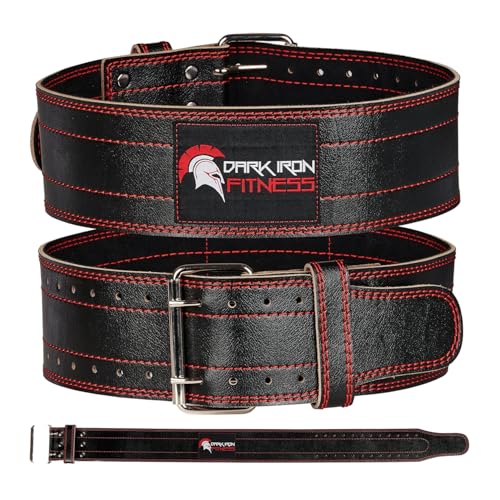
- 4-inch genuine leather support with reinforced stitching
- Twelve holes provide 1-inch fit adjustments
- Double-prong buckle and keeper loop secure excess length
Best For: Lifters wanting versatile leather support and precise sizing
Best Quick-Locking Belt
Gymreapers Quick Locking Weightlifting Belt

- Quick-locking buckle for fast adjustments
- Uniform 4-inch support profile
- Lightweight reinforced nylon construction
Best For: Fast transitions between heavy lifts and cross-training
Best Suede-Lined Leather Belt
Genuine Leather Weightlifting Belt

- Double-sided leather construction
- Suede lining for added comfort
- Reinforced stitching and buckle closure
Best For: Traditional leather support during regular strength training
Best Adjustable Leather Belt
RDX Cowhide Leather Weightlifting Belt

- 7 mm cowhide leather construction
- 4-inch and 6-inch back options
- 10-hole dual-pronged roller buckle
Best For: Customizable lumbar support for squats and deadlifts
Maximum Support Pick – 13mm Powerlifting Lever Belt
For lifters seeking a weightlifting belt for heavy squats, this 13mm suede-leather lever belt emphasizes maximum core and lower-back support. Its 4-inch width, heavy-duty lever, and USPA and IPL approval make it suited to serious strength training.
Best For: Experienced lifters prioritizing maximum support for heavy squats and deadlifts.
Pros:
- Thick 13mm genuine suede leather provides substantial support.
- 4-inch width stabilizes the back, abs, and core.
- Chrome lever enables quick tightening and loosening.
- USPA and IPL approved.
Cons:
- The rigid 13mm construction may feel excessive for beginners.
- Accurate waist measurement is important because sizing is not based on pants size.
This is the most support-focused option in the group, with competition approval and a durable lever design. Choose it when bracing strength matters more than a lightweight, flexible feel.
Adjustable Lever Choice – MANUEKLEAR 10mm Lever Belt
This 10mm leather lever belt is a practical weightlifting belt for heavy squats when you want firm support with quick fit adjustments. Its 4-inch width and adjustable lever are designed for squats, deadlifts, powerlifting, and general strength training.
Best For: Men and women who want a versatile lever belt with a broad adjustment range.
Pros:
- 10mm thick, 4-inch-wide leather construction offers sturdy support.
- Lever adjusts across a listed 24- to 45-inch range.
- One-second locking design is convenient between sets.
- Suitable for squats, deadlifts, powerlifting, and strength training.
Cons:
- Leather and lever construction may feel less flexible than a hook-and-loop belt.
- The listing recommends using the sizing information carefully for fit.
Compared with a thicker 13mm belt, this model offers a slightly less substantial profile while retaining a rigid lever closure. It is a balanced choice for athletes who want support across multiple strength movements.
Comfort-Focused Pick – RitFit 6-Inch Weight Lifting Belt
If you want a weightlifting belt for heavy squats with a wider, padded design, the RitFit uses a 6-inch contoured profile to support the back, abs, and core. Its reinforced tricot construction, hook-and-loop strap, and stainless steel buckle make it easy to adjust during training.
Best For: Lifters who prefer broad padded support and quick hook-and-loop adjustments.
Pros:
- Extra-wide 6-inch contoured profile provides comprehensive support.
- Reinforced tricot is designed for comfort and durability.
- Hook-and-loop strap and stainless steel buckle allow quick adjustments.
- Available in multiple sizes and colors.
Cons:
- Its wider profile may feel bulkier than a 4-inch leather belt.
- Hook-and-loop closure is less competition-oriented than a lever design.
This belt favors comfort and adjustability over the rigid feel of a traditional powerlifting lever belt. It is a sensible option for general strength training, especially when you want added lumbar coverage.
Lightweight Leather Pick – Gymreapers 4-Inch Leather Belt
The Gymreapers leather belt is a practical weightlifting belt for heavy squats when you want a traditional 4-inch support profile without a bulky feel. Real leather, reinforced stitching, a lightweight metal buckle, and multiple adjustment holes provide a durable, form-fitting design.
Best For: Lifters seeking a lightweight leather belt for squats, bodybuilding, and general strength work.
Pros:
- Real reinforced leather and stitching are built for durability.
- 4-inch width supports the back, spine, and core.
- Lightweight 1.5-pound design is easy to carry and store.
- Multiple adjustment holes help fine-tune the fit.
Cons:
- Traditional buckle adjustment is slower than a lever closure.
- Its support profile is less substantial than the 10mm and 13mm lever belts.
This model offers a useful middle ground between durable support and portability. Choose it if you want real leather and a lower-bulk design rather than the maximum rigidity of a thick powerlifting belt.
Best Quick-Locking Pick – Element 26 Self-Locking Weight Lifting Belt
If you want a weightlifting belt for heavy squats that is quick to secure and easy to adjust, the Element 26 Self-Locking Belt is a practical option. Its 4-inch nylon design is breathable, flexible, and engineered to provide consistent midsection pressure without a break-in period.
Best For: Lifters who prioritize fast, secure adjustments for squats, deadlifts, cleans, and other functional fitness movements.
Pros:
- Self-locking full-metal buckle engages under load, with a quick-release roller for removal.
- Infinitely adjustable nylon construction allows precise pressure control.
- Breathable, hand-washable material folds easily for gym-bag storage.
- Designed to meet requirements for sanctioned Olympic lifting and functional fitness events.
Cons:
- Nylon provides a more flexible feel than a rigid leather belt.
- The supplied listing is for a medium size, so careful sizing is important.
Choose this belt when convenience, adjustability, and quick repositioning matter as much as support. Its straight 4-inch profile is suited to multiple lifting positions and requires no break-in period.
Best Heavy-Duty Leather Pick – Gymreapers 7MM Pro Leather Lifting Belt
For lifters seeking a weightlifting belt for heavy squats with a firm, traditional feel, the Gymreapers 7mm Pro Leather Belt offers substantial support. Its real-leather construction, suede lining, and 4-inch tapered back are designed for stability while reducing pressure on the sides.
Best For: Serious strength trainees who prefer a thick leather belt with a secure dual-prong buckle.
Pros:
- 7mm real-leather construction is built for heavy squat and strength training sessions.
- Suede lining improves comfort against the skin.
- Dual-prong steel buckle provides an adjustable, firm fit.
- 4-inch tapered back supports the spine while maintaining a contoured profile.
Cons:
- Leather is less flexible and less breathable than nylon.
- Dual-prong buckles can take more time to fasten and remove than quick-lock systems.
- Sizing must be based on a measurement around the navel, not a usual waist-size label.
This is a strong match for users who value rigid support and durable leather construction over lightweight portability. Measure around the belly button carefully before choosing a size.
Best Adjustable Leather Value – Dark Iron Fitness Genuine Leather Belt
The Dark Iron Fitness Genuine Leather Belt is a practical weightlifting belt for heavy squats when you want leather support with plenty of adjustment points. Its 4-inch profile, reinforced stitching, and double-prong buckle are designed to help stabilize the core during squats, deadlifts, and other strength work.
Best For: Men and women who want a versatile leather belt with precise hole spacing for gym or general strength-training use.
Pros:
- Genuine leather construction uses double-row stitching and reinforced edges.
- Twelve adjustment holes spaced at 1-inch intervals allow a precise fit.
- Double-prong metal buckle and keeper loop help secure the belt during lifts.
- Available in sizes intended to cover approximately 22- to 49-inch waists.
Cons:
- Leather requires wiping and occasional conditioning for maintenance.
- The double-prong buckle may be slower to adjust than a self-locking design.
- The listing’s supplied size is medium, so sizing should be checked carefully.
This belt suits lifters who want a supportive leather design without giving up fine adjustment. Measure around the belly button rather than relying on pants size, and condition the leather to help maintain flexibility.
Best Quick-Locking Belt – Gymreapers Quick Locking Weightlifting Belt
If you want a weightlifting belt for heavy squats that is quick to secure between sets, the Gymreapers Quick Locking Belt uses a quick-locking buckle and a uniform 4-inch profile. Its nylon construction keeps the design relatively lightweight while providing a consistent fit around the torso.
Best For: Lifters who prioritize fast adjustments for squats, deadlifts, Olympic lifting, and cross-training.
Pros:
- Quick-locking buckle supports fast fastening and release.
- Uniform 4-inch width provides consistent support around the belt.
- Made from high-grade nylon with reinforced stitching.
- Tested for powerlifting, Olympic lifting, bodybuilding, and cross-training.
Cons:
- Nylon construction may not suit lifters who prefer a leather belt.
- Accurate sizing requires measuring around the navel rather than using pant size.
The Gymreapers belt is a practical option when convenience and low downtime matter. Its quick-locking system is especially useful for workouts that move between exercises, while the 4-inch shape gives it a straightforward support profile for heavy training.
Best Suede-Lined Leather Belt – Genuine Leather Weightlifting Belt
For shoppers seeking a weightlifting belt for heavy squats with a traditional leather build, this model combines double-sided leather with a suede inner lining. Its widened structure and buckle closure are designed for strength training, powerlifting, and general gym use.
Best For: Lifters who want a leather belt with a suede lining for added comfort during repeated workouts.
Pros:
- Double-sided leather construction is designed for durability.
- Suede lining adds padding and helps protect the skin.
- Reinforced top stitching supports high-strength use.
- Adjustable buckle accommodates the listed waist-size ranges.
Cons:
- Leather construction is less lightweight than a nylon alternative.
- The listed design is 6 inches wide, which may feel substantial for some lifters.
- Sizing requires true waist measurement rather than pant size.
This belt emphasizes a supportive, traditional leather feel with interior suede for comfort. It is a sensible choice for lifters who prefer a wider belt and reinforced construction for regular squats, deadlifts, and strength-training sessions.
Best Adjustable Leather Belt – RDX Cowhide Leather Weightlifting Belt
The RDX Cowhide Leather Belt is a strong candidate for a weightlifting belt for heavy squats when you want leather construction, a choice of 4- or 6-inch back widths, and fine-grained adjustment. Its dual-pronged roller buckle works with 10 holes to help dial in the fit.
Best For: Lifters who want cowhide leather, a wide padded lumbar section, and multiple adjustment points for squats and deadlifts.
Pros:
- 7 mm cowhide leather is built for durability and pressure management.
- Available with a 4-inch or 6-inch back for different support preferences.
- Ten holes provide more fit-adjustment options.
- Dual-pronged roller buckle and reinforced rivets help resist slipping.
Cons:
- Leather construction may feel heavier or less flexible than nylon.
- Choosing between 4-inch and 6-inch versions requires considering personal comfort and fit.
- Size selection depends on measuring around the lower back and belly button, not pant size.
With its cowhide build, suede interior, and adjustable roller buckle, the RDX offers a feature-rich setup for serious strength training. The choice of back width and 10-hole adjustment pattern makes it particularly adaptable for squat-focused routines.
How We Picked the Best Weightlifting Belt for Heavy Squats
We compared these belts by construction, thickness, width, closure system, adjustability, and intended use. Priority went to models that offer a secure fit and dependable torso support for squats, while also considering whether each design is practical for warm-ups, accessory work, and different body shapes.
Leather lever and prong belts generally provide the rigidity serious powerlifters want. Quick-lock and self-locking belts are often easier to adjust between exercises, while padded or tapered designs may offer a more comfortable compromise for general strength training.
Quick Comparison
| Best For | Look For | Typical Advantage |
|---|---|---|
| Maximum squat stability | 10mm–13mm leather, lever closure | Very rigid, repeatable fit |
| Adjustable powerlifting use | Prong buckle and multiple holes | Fine-tuned sizing |
| Fast transitions | Quick-lock or self-locking buckle | Easy on/off between sets |
| General gym training | Moderate width or padded support | Greater comfort and versatility |
Key Buying Factors for a Weightlifting Belt for Heavy Squats
Thickness and Stiffness
A thicker belt typically resists bending more effectively and creates a firm brace for heavy attempts. A 10mm leather belt is a common strength-training choice; 13mm models can feel more substantial but may require a longer break-in period. Extra stiffness is not automatically better if it prevents you from setting your brace comfortably.
Width and Profile
Four-inch belts provide consistent support around much of the torso and are popular for squats. Six-inch or heavily padded backs can feel supportive, but they may interfere with hip position or dig into the ribs depending on your anatomy. A tapered design can improve comfort when squatting deep.
Closure and Fit
Lever belts offer quick, repeatable tightening, while double-prong buckles provide broad adjustability. Quick-lock systems are convenient, especially when moving between exercises. Measure your waist according to the manufacturer’s instructions rather than relying on your pants size, and position the belt where it allows a strong brace without restricting breathing.
Construction and Maintenance
Check the leather or synthetic material, stitching, buckle hardware, edge finishing, and warranty. A belt should stay flat and secure under tension. Leather models may need a break-in period and should be kept dry; metal components should be inspected regularly for looseness or damage.
Who Should Buy Which Weightlifting Belt for Heavy Squats?
Choose a stiff 10mm or 13mm lever belt if heavy squats and powerlifting-style training are your priority. Select a prong-buckle leather belt if you want more incremental adjustment or share the belt across different training loads. A self-locking or quick-lock model suits lifters who value speed and frequent changes, while a padded or moderately rigid belt is often the better choice for beginners, bodybuilding, and mixed gym sessions.
Whatever style you choose, a belt should support—not replace—proper bracing, progressive programming, and sound squat technique.