The best foam plyometric boxes make jump training, step-ups, and lower-body conditioning more approachable at home. Their padded construction can reduce the consequences of missed landings while still providing multiple training heights.
We compared 10 popular 3-in-1 models by height options, surface traction, construction, versatility, and home-gym practicality. Use the guide below to narrow your choice based on experience, available space, and the exercises you plan to perform.
Best 10 Foam Plyometric Boxes Picks for 2026
Best Overall Foam Plyometric Box

- Three heights: 16, 20, and 24 inches
- Dense foam core with textured anti-slip vinyl
- Fully assembled and rated up to 400 pounds
Best For: Adjustable, lower-impact home and functional fitness training
Best Compact Wood Option
CAP Barbell 3-in-1 Plyometric Box

- Three heights: 12, 14, and 16 inches
- Interlocking engineered-wood construction
- Textured surface and built-in carry handles
Best For: Lower-height training with a firm wood platform
Best Cushioned Wooden-Core Box

- Three heights: 12, 14, and 16 inches
- Wooden core with EVA foam and vinyl padding
- Non-slip surface and stated 450-pound capacity
Best For: Cushioned home-gym training with added structural support
Best Lightweight Foam Box
BalanceFrom 3-in-1 Foam Plyometric Jump Box

- Three heights: 16, 20, and 24 inches
- High-density foam with a textured anti-slip surface
- Lightweight 10-pound design for easy movement
Best For: Portable home workouts and beginner-friendly plyometrics
Adjustable Training Pick
HANDBODE 3-in-1 Foam Plyometric Box

- Rotates between 20, 24, and 30 inches
- High-density foam cushions landings
- Supports up to 350 pounds
Best For: Progressive home workouts across multiple fitness levels
Stable Home-Gym Choice
CAP 3-in-1 Foam Plyometric Box
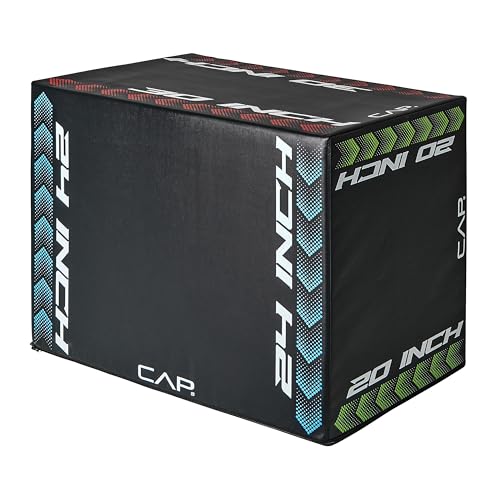
- Rotates between 20, 24, and 28 inches
- Weighted core helps limit movement
- Supports users up to 250 pounds
Best For: Stable home HIIT and functional training
Portable Cushioned Option

- Three rotating height settings
- Cushioned foam and pearl cotton core
- Lightweight, no-assembly design
Best For: Portable indoor HIIT and step-up workouts
Best Value
BalanceFrom 3-in-1 Foam Plyometric Box

- Three flip-adjustable height options
- Shock-absorbing foam with textured PVC cover
- Supports jumps, step-ups, and strength work
Best For: Versatile home gym training
Best Height Range

- Height configurations can reach 30 inches
- High-density EPE foam cushions landings
- Easy-clean PU cover and no assembly
Best For: Progressive HIIT and jump training
Best Lightweight Option
Goplus 16 x 20 x 24 Foam Plyo Box

- Three heights: 16, 20, and 24 inches
- Lightweight 7-pound design
- Durable, sweat-resistant PU cover
Best For: Portable home and studio workouts
Best Overall Foam Plyometric Box – REP Soft Plyo Box
The REP Soft Plyo Box is a versatile choice for foam plyometric boxes, offering three heights in one padded platform. Its dense foam core, textured vinyl cover, and ready-to-use design suit home gyms, studios, and functional fitness sessions.
Best For: Athletes and beginners who want adjustable heights, softer landings, and a multipurpose training platform.
Pros:
- Rotates between 16-, 20-, and 24-inch heights.
- High-density foam and an anti-slip vinyl cover help provide softer, stable landings.
- Supports up to 400 pounds and arrives fully assembled.
- Works for jumps, step-ups, squats, push-ups, balance work, and glute thrusts.
Cons:
- Offers only three fixed height options.
- Its padded construction may not provide the same rigid feel as a wood box.
With its broad exercise range and three height settings, this REP model is a strong all-around option when impact reduction and versatility matter.
Best Compact Wood Option – CAP Barbell 3-in-1 Plyometric Box
The CAP Barbell 3-in-1 Plyometric Box is a compact alternative to foam plyometric boxes, using an engineered-wood platform with interlocking construction. It provides three lower height settings and practical features for home-gym conditioning.
Best For: Home users who prefer a firm wood training surface and modest 12-, 14-, and 16-inch heights.
Pros:
- Rotates between 12-, 14-, and 16-inch training heights.
- Interlocking panels and countersunk screws support a stable assembled platform.
- Textured surface adds traction for jumps and step-ups.
- Built-in carry handles make repositioning easier.
Cons:
- Does not have foam padding for softer impact.
- Its maximum recommended load is 300 pounds.
- The height range is lower than several other options in this roundup.
This CAP Barbell box makes sense for progressive step-ups and lower-height plyometric work when a rigid, portable wood design is more important than cushioning.
Best Cushioned Wooden-Core Box – Yes4All Soft-Padded Plyo Box
The Yes4All Soft-Padded Plyo Box combines a wooden core with EVA foam cushioning and a vinyl/PVC exterior. Among foam plyometric boxes, its padded construction offers a balance of structural support, impact absorption, and three-position versatility.
Best For: Home-gym users seeking a cushioned box with a strong wooden core and a high stated weight capacity.
Pros:
- Provides 16-, 14-, and 12-inch height options.
- Wooden core, EVA foam, and vinyl cover combine support with cushioning.
- Non-slip, waterproof PVC surface adds traction.
- Rated to hold up to 450 pounds and includes a one-year warranty.
Cons:
- The listed height range tops out at 16 inches.
- It has fewer height options than some taller models.
- Its 13.2-pound weight may be less convenient to move than lighter foam-only designs.
Choose this model if you want the reassuring structure of a wooden core while retaining a padded surface for step-ups, jumps, and HIIT training.
Best Lightweight Foam Box – BalanceFrom 3-in-1 Foam Plyometric Jump Box
The BalanceFrom 3-in-1 Foam Plyometric Jump Box is designed for easy home-gym use, combining three jump heights with a lightweight 10-pound foam build. Its textured surface supports traction while the foam construction helps soften contact during training.
Best For: Beginners and home users who prioritize portability, softer impact, and quick height changes.
Pros:
- Rotates between 16-, 20-, and 24-inch heights.
- High-density foam helps minimize shin scrapes and soften impact.
- Textured anti-slip surface supports steadier jumps, landings, and step-ups.
- At 10 pounds, it is easy to move and store.
Cons:
- Its foam construction may feel less rigid than a wooden-core box.
- The notes do not specify a maximum weight capacity.
- It is primarily suited to the listed three height settings.
This BalanceFrom box is a practical pick for compact spaces and mixed home workouts where portability and a softer landing surface take priority.
Adjustable Training Pick – HANDBODE 3-in-1 Foam Plyometric Box
The HANDBODE is a practical choice if you want foam plyometric boxes with three training heights in one compact unit. Rotate it to select 20, 24, or 30 inches, while the high-density foam and non-slip PVC cover support more comfortable, stable home workouts.
Best For: Beginners through advanced users who want adjustable box jumps, step-ups, squats, push-ups, and dips.
Pros:
- Three height options accommodate progressive training.
- High-density foam helps absorb landing impact.
- Supports up to 350 pounds and weighs 16 pounds.
- Non-slip PVC surface is sweat-resistant and easy to wipe clean.
Cons:
- Its 30-inch maximum height may be more than some beginners need.
- The supplied notes do not specify internal weighting for added stability.
With the highest stated weight capacity in this roundup and a useful 20-to-30-inch range, the HANDBODE is a strong all-around option for users who expect their training needs to progress.
Stable Home-Gym Choice – CAP 3-in-1 Foam Plyometric Box
The CAP 3-in-1 is one of the more stability-focused foam plyometric boxes, combining 20-, 24-, and 28-inch heights with a weighted core. Its dense foam landing surface and durable PVC cover suit box jumps, step-ups, HIIT, and general functional training.
Best For: Home-gym users who prioritize a forgiving landing surface and reduced movement during dynamic exercises.
Pros:
- Three rotating heights support progressive workouts.
- Weighted core helps reduce tipping and unwanted movement.
- High-density foam is more forgiving than rigid box materials.
- PVC cover is durable and easy to maintain.
Cons:
- Its 250-pound maximum recommendation is lower than the HANDBODE’s stated capacity.
- The maximum height is 28 inches rather than 30 inches.
The CAP stands out when stability is a priority. The integrated weighted core adds reassurance for explosive movements, while the three-height design keeps the box useful for varied conditioning sessions.
Portable Cushioned Option – NEWBULIG 3-in-1 Jump Box
The NEWBULIG is a portable alternative among foam plyometric boxes, with three rotating heights and a cushioned foam and pearl cotton core. Its textured Oxford cloth cover is designed to add grip, and the lightweight, no-assembly format makes it convenient for indoor home training.
Best For: Users who want a lightweight box for home HIIT, step-ups, agility work, and indoor conditioning.
Pros:
- Three height settings support varied jump and step-up drills.
- Foam and pearl cotton construction cushions landings.
- Textured cover increases surface friction.
- Small and large versions weigh 10 and 16 pounds, respectively, with no assembly required.
Cons:
- The supplied notes do not state a maximum user weight.
- Unlike the other listed models, the notes identify the material as plastic rather than specifying a PVC cover.
- The available size options may require checking the listing carefully before purchase.
Choose the NEWBULIG when portability and easy setup matter most. It offers cushioning and three training levels without assembly, though shoppers who need a stated weight capacity may prefer a model with that specification.
Best Value – BalanceFrom 3-in-1 Foam Plyometric Box
The BalanceFrom 3-in-1 foam plyometric box is a practical choice for home gyms that need adjustable training heights without a bulky setup. Its flip design provides three height options, while the foam construction and textured PVC exterior support jumps, step-ups, and strength work.
Best For: Home users seeking versatile foam plyometric boxes for HIIT, cardio, and strength exercises.
Pros:
- Three height options from a simple flip design
- Shock-absorbing foam helps reduce landing impact
- Textured PVC surface supports secure footing
- Supports up to 330 pounds according to the listed specifications
Cons:
- At 10 pounds, it may be less convenient to move than lighter foam boxes
- The listed dimensions provide a maximum height of 24 inches
With its broad exercise range and stable, non-slip surface, this BalanceFrom model offers a well-rounded option for everyday home training. It is especially useful if you want adjustable heights and a box that can also support push-ups, split squats, and other movements.
Best Height Range – Goplus 3-in-1 Foam Plyo Box
The Goplus 3-in-1 foam plyometric box stands out for offering selectable height ranges that can reach up to 30 inches, depending on the configuration. Its high-density EPE foam, anti-slip PU cover, and ready-to-use design make it suitable for varied home gym and HIIT sessions.
Best For: Users who want foam plyometric boxes with multiple height configurations and a high listed weight capacity.
Pros:
- Offers three height combinations, including an option reaching 30 inches
- High-density EPE foam provides soft landings with firm support
- Waterproof PU cover wipes clean and has a hidden zipper
- Listed weight capacity is up to 440 pounds
Cons:
- The supplied notes do not identify which size configuration is included beyond the listed 16 x 14 x 12-inch dimensions
- Its smaller listed footprint may provide less landing area than larger models
This is a strong fit when height progression is a priority. It arrives assembled and weighs 5.9 pounds, making it relatively easy to reposition, while the PU cover simplifies cleanup after demanding workouts.
Best Lightweight Option – Goplus 16 x 20 x 24 Foam Plyo Box
This Goplus foam plyometric box combines a larger 16 x 20 x 24-inch format with three action heights for adaptable home training. The dense EPE foam core is designed to cushion landings, while the tear-resistant PU cover is water- and sweat-resistant for easier maintenance.
Best For: Home or studio users who want a lightweight foam plyometric box for jumps, step-ups, agility drills, and strength work.
Pros:
- Flips between 16, 20, and 24 inches
- Dense EPE foam helps cushion landings and resist deformation
- Water- and sweat-resistant PU cover wipes clean quickly
- Weighs 7 pounds while supporting up to 352 pounds
Cons:
- Height options top out at 24 inches
- A 90-day manufacturer-defect warranty is listed
Its combination of manageable weight, three useful heights, and a durable easy-clean cover makes this a flexible choice for frequent workouts. Consider it if you want a foam box that can move easily between rooms while still supporting a broad exercise menu.
How We Picked the Best Foam Plyometric Boxes
We focused on the features that matter most during repeated home workouts: stable construction, useful height settings, a grippy landing surface, durable upholstery, and a shape that is easy to reposition. Most models in this roundup use a 3-in-1 design, allowing you to rotate the box for different heights rather than buying multiple platforms.
We also considered how well each option suits common movements, including box jumps, step-ups, elevated push-ups, Bulgarian split squats, and conditioning circuits. A soft exterior is helpful, but it should not come at the expense of stability or a predictable landing area.
Quick Comparison
Choose a model with three height settings if more than one person will use it or if you are progressing from beginner step-ups to higher jumps. Smaller 16-, 20-, and 24-inch configurations are generally practical for home gyms, while taller options may better suit experienced athletes who need a greater challenge.
- Best for adjustable home training: A 3-in-1 box with clearly differentiated heights.
- Best for beginners: A lower, wider soft box with a strongly textured top.
- Best for frequent HIIT: High-density foam, reinforced seams, and an easy-clean cover.
- Best for shared spaces: A manageable footprint and a design that is easy to carry or store.
Key Buying Factors for Foam Plyometric Boxes
Height and Dimensions
Measure the available floor area before ordering, then check every usable height rather than relying only on the product title. Beginners should prioritize a low setting that supports controlled landings. More advanced users should confirm that the tallest setting matches their training goals without forcing unsafe jump mechanics.
Stability and Landing Surface
A box should stay planted when you jump, step, or shift your weight. Look for a broad base, dense interior foam, and a non-slip cover or bottom. Place it on a level, dry surface and leave enough clearance around it for safe takeoffs and landings.
Padding and Construction
High-density foam can provide a useful balance of cushioning and support. Check for a durable PU or vinyl-style cover, reinforced stitching, and surfaces that can be wiped clean. Softer padding may feel more forgiving, but excessive compression can make the box unstable.
Versatility and Storage
Consider whether you will use the box for step-ups, strength exercises, mobility work, or only jumps. Handles, moderate weight, and a compact footprint make repositioning easier, especially in a multipurpose room.
Who Should Buy Which Foam Plyometric Boxes?
New exercisers should choose a stable soft box with a low starting height and a highly visible, non-slip top. Progressive home-gym users will benefit most from a true 3-in-1 design with three practical heights and enough surface area for repeated drills.
HIIT and circuit trainees should prioritize cleanable upholstery, secure traction, and a size that can be moved quickly between exercises. Experienced jumpers should verify the maximum height, box dimensions, and weight capacity while keeping technique and landing control ahead of height.
Whichever model you select, begin with step-ups or low jumps, test the box for movement before each session, and increase height only when you can land quietly and under control.