The best elastic stretching straps make it easier to control range of motion, target tight muscles, and build a consistent mobility routine without forcing a stretch.
We compare 10 looped and resistance-style options for yoga, Pilates, rehabilitation, dance, and home exercise, focusing on adjustability, comfort, durability, and ease of use.
Best 10 Elastic Stretching Straps Picks for 2026
Best Elastic Loop Strap
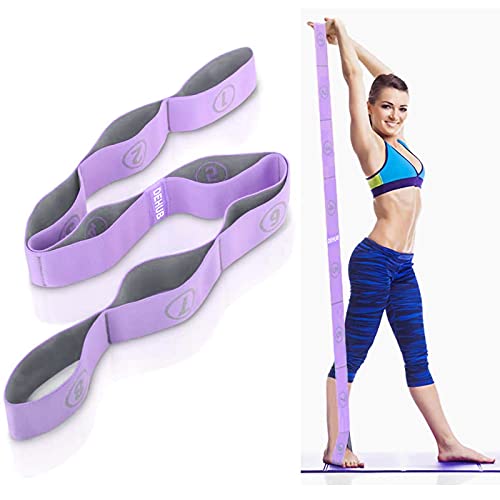
- Elastic design extends up to 2.5 times its length
- Padded loops support comfortable positioning
- Washable and compact for travel
Best For: Assisted stretching, mobility work, and rehabilitation
Best Resistance Elastic Strap

- Eleven loops offer 15–45 pounds of resistance
- Fabric construction is designed not to roll
- Supports stretching, activation, and strength work
Best For: Progressive resistance training with flexibility work
Best Non-Elastic Alternative

- Non-elastic webbing avoids snap-back
- Loops support controlled range-of-motion work
- Designed for therapy, yoga, and mobility training
Best For: Rehabilitation and controlled stretching
Best Rehab Stretching Strap
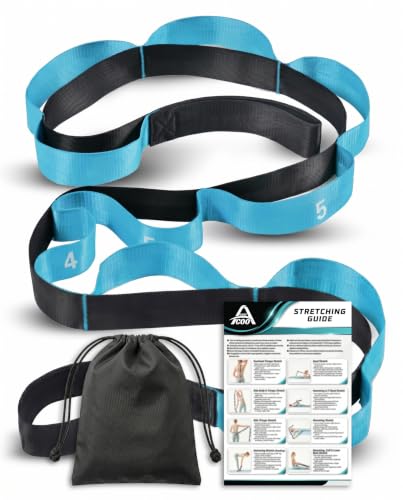
- Professional version has 10 numbered loops
- Includes pouch and exercise guide in the 86-inch style
- Non-elastic nylon provides stable positioning
Best For: Rehabilitation, leg lifting, and tracked flexibility progress
Best for Versatile Resistance Training

- Three color-coded resistance levels
- Latex-free 5-foot TPE bands
- Can be wrapped, knotted, or doubled
Best For: Strength training, rehabilitation, yoga, and Pilates
Best for Loop-Based Stretching

- Eleven independent grip loops
- 55-inch lightweight nylon design
- Useful for yoga and physical therapy
Best For: Assisted flexibility work, athletes, dancers, and rehabilitation
Best for Stable Assisted Stretches

- Long 75-inch nylon strap
- Ten adjustable grip loops
- Firm support without elastic rebound
Best For: Yoga, Pilates, physical therapy, and recovery stretching
Best for Recovery Support

- Non-elastic for steady, controlled holds
- Multiple loops adjust stretch depth
- Supports home mobility and leg lifting
Best For: Home physical therapy and post-surgery mobility
Best for Versatile Training
Loop Strap with Neoprene Handles

- Numbered loops support repeatable positioning
- Neoprene handles improve grip comfort
- Includes carry bag and exercise guide
Best For: Yoga, physical therapy, and multi-sport stretching
Best for Everyday Flexibility
Abiarst 10-Loop Stretching Strap
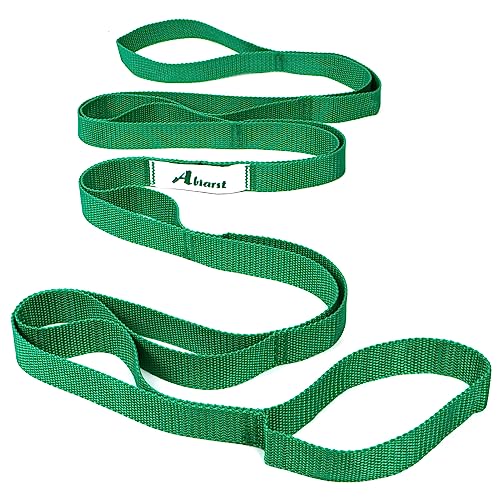
- Washable fabric resists fraying and breaking
- Ten loops offer flexible positioning
- Suitable for stretching and multiple sports
Best For: Daily flexibility routines and exercise
Best Elastic Loop Strap – Multi-Loop Stretch Strap
This elastic stretching strap uses multiple loops to make assisted stretching easier to position during yoga, Pilates, dance, gymnastics, warm-ups, and rehabilitation. Its fabric construction, padded outer loops, and compact design make it a practical option for home or travel use.
Best For: Users who want an elastic, looped strap for flexibility work, mobility training, and post-injury or post-surgery rehabilitation.
Pros:
- Multiple loops help adjust positioning for different stretches.
- Elastic construction can extend up to 2.5 times its length.
- Neoprene-padded outer loops add comfort during use.
- Washable and compact for gym, class, or travel.
Cons:
- Elastic tension provides less rigid control than a non-elastic strap.
- Only one strap is included.
This is a versatile pick if you prefer a forgiving elastic stretching strap with loop options. It is especially useful for assisted mobility work and general flexibility routines.
Best Resistance Elastic Strap – 11-Loop Fabric Stretch Band
This 11-loop elastic stretching strap doubles as a resistance band, offering adjustable tension from 15 to 45 pounds. Numbered loops and position markers help with grip alignment, while the 52-inch fabric design stays flat for stretching, warm-ups, activation, and strength exercises.
Best For: Users seeking one elastic stretching strap for both flexibility training and progressively heavier resistance workouts.
Pros:
- Eleven grip positions provide adjustable resistance from 15 to 45 pounds.
- Progressive tension starts gently and increases as the band stretches.
- Woven fabric is designed to stay flat without rolling or pinching.
- Folds flat for home, gym, or travel workouts.
Cons:
- Its resistance-focused design may be more than needed for simple assisted stretching.
- One resistance band is included, rather than multiple separate bands.
Choose this elastic stretching strap when you want stretching and strengthening in the same tool. The numbered loops make it easier to repeat hand placement as your routine progresses.
Best Non-Elastic Alternative – Trideer Loop Stretching Strap
Unlike elastic stretching straps, this Trideer model uses non-elastic woven webbing for controlled mobility work. Its evenly spaced loops let you adjust positioning without snap-back, making it suited to hamstring, hip, calf, shoulder, back, and post-surgery range-of-motion exercises.
Best For: Physical therapy, rehabilitation, and users who prefer steady manual control instead of elastic recoil.
Pros:
- Non-elastic construction provides predictable tension and control.
- Multiple loops support varied stretching positions.
- Reinforced woven webbing is designed for repeated daily use.
- Compact enough for the gym, clinic, or travel.
Cons:
- It does not provide the assistance or rebound of elastic stretching straps.
- The supplied details list a 75-inch length, while the item highlight also mentions 81 inches.
This is the better choice for controlled stretching rather than resistance-based exercise. It is particularly relevant when avoiding snap-back is a priority during rehabilitation or range-of-motion work.
Best Rehab Stretching Strap – 86-Inch Loop Stretch Strap
This non-elastic stretching strap is available in two configurations: an 86-inch professional version with 10 numbered loops, pouch, and exercise guide, or a lighter 75-inch minimalist version. Both use nylon construction for stable leverage during rehabilitation, leg lifting, flexibility training, and everyday mobility work.
Best For: Users who want a non-elastic strap with a choice of detailed numbered loops or a simpler lightweight format.
Pros:
- The 86-inch version offers 10 numbered sections for tracking progress.
- Professional version includes a carry pouch and guided workout booklet.
- Non-elastic nylon supports steady positioning without deformation.
- Can assist with leg positioning for people with weak or injured legs.
Cons:
- Details describe two sizes and configurations, so buyers must select the preferred option.
- Non-elastic nylon is less forgiving than elastic stretching straps.
This option stands out for rehabilitation users who value length, numbered positioning, and included guidance. The minimalist configuration may also suit travelers or gym users who prefer less bulk.
Best for Versatile Resistance Training – Long Elastic Exercise Bands
If you want elastic stretching straps that can also support strength training, this three-band set offers a flexible option for home, gym, clinic, or travel workouts. Each latex-free TPE band measures 5 feet long by 6 inches wide and provides a different resistance level.
Best For: Strength training, rehabilitation, yoga, Pilates, and users who want multiple resistance levels in one portable set.
Pros:
- Includes light, medium, and extra-heavy resistance levels.
- Latex-free, non-toxic TPE construction.
- Long, wide bands can be wrapped, knotted into loops, or doubled for added tension.
- Includes an illustrated guide with 12 exercises.
Cons:
- The set does not include handles or dedicated loop closures.
- Its strength-training focus may be more than needed for basic assisted stretching.
This is a strong choice if you want one portable set for stretching, rehabilitation, and progressive resistance work. The color-coded levels make it easier to increase challenge as your workouts develop.
Best for Loop-Based Stretching – 11-Loop Stretch Strap
For targeted flexibility work, this 55-inch stretching strap uses 11 independent loops to provide multiple hand and foot positions. Its nylon construction is designed for yoga, Pilates, ballet, CrossFit, and physical therapy routines.
Best For: Athletes, dancers, and anyone who wants adjustable grip points for assisted stretching and range-of-motion exercises.
Pros:
- Eleven independent loops make length and grip adjustments straightforward.
- Supports assisted stretches, poses, and flexibility training.
- Lightweight design weighs 2.72 ounces.
- Suitable for yoga, Pilates, ballet, CrossFit, and physical therapy.
Cons:
- Its 55-inch length may offer less reach than longer straps.
- The nylon strap is designed for controlled stretching rather than elastic resistance.
The loop layout is the main advantage here: it lets users gradually change their grip and challenge flexibility in a controlled way. It is a practical pick for guided stretches where stability and positioning matter.
Best for Stable Assisted Stretches – 75-Inch Non-Elastic Strap
These elastic stretching straps are not all alike: this model is deliberately non-elastic, giving you a stable nylon platform for controlled foot, leg, waist, and hand stretches. Its 75-inch length and 10 loops offer plenty of positioning options for beginners and experienced users.
Best For: Yoga, Pilates, physical therapy, postoperative recovery, and users who prefer firm, predictable support during stretches.
Pros:
- Long 75-inch strap provides broad positioning flexibility.
- Ten loops help users adjust their grip during stretches.
- Non-elastic nylon offers stable, consistent resistance.
- Designed for stretching, physical therapy, and recovery routines.
Cons:
- Because it is non-elastic, it does not provide spring-like resistance.
- At 1 inch wide, it may feel narrower than wider exercise bands.
This strap is best when control and stability matter more than stretch or rebound. The extra length is particularly useful for beginners and exercises that require more reach around the feet or legs.
Best for Recovery Support – Trideer Loop Stretching Strap
If you want elastic stretching straps but prefer a controlled, no-rebound feel, this Trideer strap is a practical option. Its non-elastic construction and multiple loops support gentle stretching, range-of-motion work, and assisted leg lifting at home.
Best For: Home physical therapy, post-surgery mobility work, and controlled stretching for the legs, hips, back, ankles, and feet.
Pros:
- Non-elastic design stays steady without sudden bounce or rebound.
- Multiple loops provide adjustable hand and foot positions.
- Can assist with leg lifting into bed or a car when mobility is limited.
- Useful across bedside assistance, physical therapy, and daily warm-ups.
Cons:
- It is not an elastic resistance band.
- At 75 inches by 1 inch, it may offer less width than some alternatives.
- Socks or light gloves may improve comfort during longer holds.
This is a focused mobility aid rather than a resistance-training strap. Choose it when stability, repeatable positioning, and gentle control matter more than stretch or rebound.
Best for Versatile Training – Loop Strap with Neoprene Handles
For shoppers comparing elastic stretching straps with more stable options, this nylon strap offers numbered loops and cushioned neoprene handles for controlled positioning. It is sized for stretching, yoga, Pilates, fitness, dance, and physical therapy.
Best For: Beginners and experienced users who want a portable, multi-sport stretching strap with grip-friendly handles and loop tracking.
Pros:
- Non-elastic nylon provides stable positioning during stretches.
- Numbered loops make it easier to monitor and repeat positions.
- Neoprene handles are designed to improve hand and foot comfort.
- Includes a carry bag and a stretching guide with basic exercises.
Cons:
- The listed version is 78 inches long and 1.5 inches wide, which may feel bulky for some users.
- It does not provide elastic resistance or rebound.
- The product has multiple size and loop-count options, so buyers should verify the selected version.
With its numbered loops, guide, and carry bag, this strap is well suited to structured routines and travel. It is a strong choice when versatility and repeatable positioning are priorities.
Best for Everyday Flexibility – Abiarst 10-Loop Stretching Strap
If you want elastic stretching straps but need a straightforward, durable mobility tool, the Abiarst 10-loop strap keeps things simple. Its washable fabric construction and non-elastic design support stretching, physical therapy, Pilates, gymnastics, and daily flexibility work.
Best For: Everyday stretching and exercise routines that need a sturdy, skin-friendly strap with roomy loop positions.
Pros:
- Durable, tight-knit fabric is described as washable and resistant to fraying or breaking.
- Ten individual loops provide multiple grip and foot-placement options.
- Longer loop dimensions are intended to provide more room for stretching.
- Works across physical therapy, yoga, fitness, Pilates, dance, ballet, and gymnastics.
Cons:
- It is non-elastic, so it will not provide resistance-band stretch or rebound.
- The strap is 75 inches by 1 inch, which may feel narrow for some users.
- No carry bag or exercise guide is listed in the supplied details.
This is a practical, no-frills choice for users who value washable fabric and broad exercise compatibility. Select it for controlled flexibility work rather than elastic resistance training.
How We Picked These Elastic Stretching Straps
We focused on the features that matter during repeated stretching sessions: loop placement, strap length, material feel, resistance, grip, portability, and versatility. The selection includes elastic bands for users who want gentle assistance or added resistance, as well as non-elastic loop straps for precise positioning and controlled physical-therapy movements.
We also considered how easily each style can support common exercises such as hamstring stretches, shoulder mobility drills, calf stretches, hip-opening work, and assisted leg lifts. A useful strap should be simple to adjust and stable enough to hold without slipping or digging into the hands and feet.
Quick Comparison
| Strap type | Best for | Main advantage | Potential drawback |
|---|---|---|---|
| Multi-loop elastic strap | General flexibility training | Progressive positioning and assistance | Can lose tension over time |
| Fabric resistance band | Stretching plus light strengthening | Comfortable, grippy feel | May provide less precise positioning |
| Non-elastic loop strap | Physical therapy and controlled stretching | Consistent length and tension | Does not provide elastic assistance |
| Long resistance band | Rehabilitation and full-body exercise | More movement and exercise options | Requires more technique and storage space |
Key Buying Factors for Elastic Stretching Straps
Elasticity and Resistance
Choose an elastic model if you want the strap to provide gentle assistance, accommodate changing angles, or double as a resistance band. Lighter resistance is generally more forgiving for mobility work. If consistent positioning is more important than spring, choose a non-elastic strap.
Loops and Adjustment
Multiple loops make it easier to change hand or foot placement without retying the strap. They are especially useful when progressing gradually or sharing the strap between users. Check that the loops are large enough for comfortable hand and foot placement.
Materials and Comfort
Fabric can feel softer and resist rolling, while smooth latex or non-latex bands may be easier to clean. If you have a latex sensitivity, select a clearly labeled non-latex option. Look for reinforced stitching, smooth edges, and handles that will not pinch during longer sessions.
Length, Portability, and Care
A longer strap works well for full-body stretches and taller users, while a compact design is easier to carry with a yoga mat or keep in a therapy bag. Follow the care instructions, avoid sharp edges, and inspect elastic material regularly for cracking, thinning, or loss of tension.
Who Should Buy Which Elastic Stretching Straps?
- For beginners: Choose a multi-loop elastic strap with moderate stretch and clear, easy-to-use loops.
- For physical therapy: A non-elastic loop strap offers predictable positioning; follow your clinician’s prescribed movements.
- For yoga and Pilates: Select a comfortable fabric or looped strap that provides control without excessive resistance.
- For athletes and dancers: A longer elastic or resistance band can support deeper mobility work and light strengthening.
- For travel: Pick a lightweight, compact strap that fits easily in a mat bag or exercise tote.
Whichever design you choose, use slow, controlled movement and stop if you feel sharp pain, numbness, or unusual discomfort. A strap should help you manage a stretch—not force your body beyond a safe range.