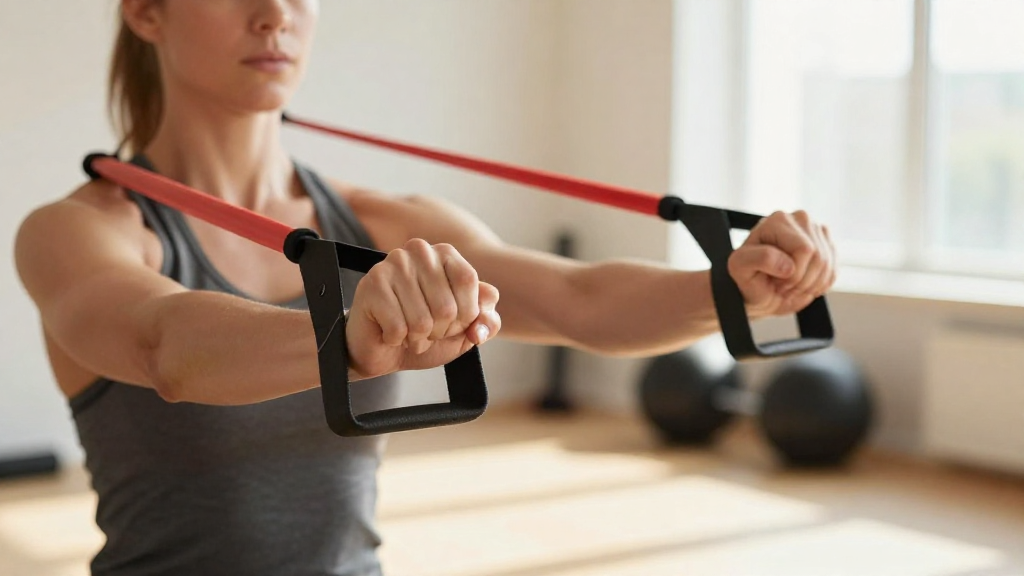
Are you looking for an effective way to improve your fitness?
A workout with resistance bands can provide a dynamic alternative to traditional weight training, helping to build strength, flexibility, and endurance.
In this guide, we’ll explore how to effectively incorporate resistance bands into your fitness routine for maximum benefits.
What Are Resistance Bands?
Resistance bands are versatile and portable exercise tools.
They come in various shapes, sizes, and resistance levels, making them suitable for all fitness levels.
Typically made of elastic material, these bands create resistance when stretched.
Benefits of using resistance bands include:
- Portability: Easy to carry and store.
- Versatility: Can be used for a wide variety of exercises.
- Joint-friendly: Provides less strain on joints compared to free weights.
- Scalability: Adjust resistance by using different band strengths or changing your grip.
How to Choose the Right Resistance Band for Your Workout?
Choosing the right resistance band is crucial for an effective workout with resistance bands.
Here’s what to consider:
-
Resistance Level: Bands come in light, medium, heavy, and extra-heavy options.
– Light bands are perfect for beginners or rehabilitation work.
– Medium bands suit intermediate users looking for a challenge.
– Heavy and extra-heavy bands are great for advanced users, focusing on strength training. -
Length: Most bands are around 4 to 6 feet long.
– Ensure the length suits your height and workout space. -
Types of Bands:
– Loop Bands: Great for lower body workouts.
– Tube Bands with Handles: Ideal for upper body exercises. -
Material: Look for durable latex or fabric bands for longevity.
What Exercises Can You Do in a Workout with Resistance Bands?
Here’s how to structure a workout with resistance bands:
Upper Body Exercises
-
Bicep Curls:
– Stand on the band with feet shoulder-width apart.
– Hold the handles or ends and curl upwards. -
Shoulder Press:
– Stand with your feet on the band, holding handles at shoulder height.
– Press up over your head. -
Tricep Extensions:
– Stand with feet on the band and hold one handle.
– Extend your arm overhead, bending at the elbow.
Core Exercises
-
Standing Oblique Crunch:
– Anchor the band under your foot.
– Pull the band upward while bringing your knee to the side. -
Russian Twists:
– Sit on the floor with legs bent.
– Hold the band with both hands, twisting your torso side to side.
Lower Body Exercises
-
Squats:
– Stand on the band with feet shoulder-width apart.
– Hold the handles at shoulder height and squat down. -
Lateral Band Walks:
– Place the band around your thighs.
– Take steps sideways to engage your glutes. -
Glute Bridges:
– Lie on your back with feet on the band.
– Pull the band down towards your hips while lifting them.
How to Structure Your Workout with Resistance Bands?
A well-structured workout with resistance bands can enhance your results.
Here’s a sample routine to get you started:
Warm-Up (5-10 Minutes)
- Dynamic stretches
- Light jogging or marching in place
- Arm circles and leg swings
Main Workout (30 Minutes)
Upper Body (10 Minutes):
– Bicep Curls: 3 sets of 12-15 reps
– Shoulder Press: 3 sets of 12-15 reps
– Tricep Extensions: 3 sets of 12-15 reps
Core (10 Minutes):
– Standing Oblique Crunch: 3 sets of 12-15 reps on each side
– Russian Twists: 3 sets of 10-15 reps on each side
Lower Body (10 Minutes):
– Squats: 3 sets of 12-15 reps
– Lateral Band Walks: 3 sets of 10 steps in each direction
– Glute Bridges: 3 sets of 12-15 reps
Cool Down (5-10 Minutes)
- Static stretching targeting all major muscle groups
- Focus on breathing to lower your heart rate
How Often Should You Do a Workout with Resistance Bands?
For optimal results, aim to perform a workout with resistance bands 2-3 times a week.
You can complement this with cardiovascular exercises on alternate days.
Listen to your body and allow proper recovery time between sessions.
Tips for Maximizing Your Workout with Resistance Bands
-
Focus on Form: Maintain proper form to prevent injuries and ensure maximum effectiveness.
-
Vary Your Routine: Change exercises and resistance levels regularly to avoid plateaus.
-
Engage Your Core: Always engage your core muscles for stabilization during exercises.
-
Combine with Other Equipment: For added variety, combine resistance bands with dumbbells or kettlebells.
-
Stay Consistent: Like any workout plan, consistency is key to seeing results.
Conclusion: Why You Should Start a Workout with Resistance Bands Today?
A workout with resistance bands is an efficient and effective way to improve strength and overall fitness.
Their versatility allows you to challenge yourself and adapt your routine as you progress.
By incorporating resistance bands into your fitness regimen, you can enhance muscle tone, improve joint health, and enjoy a well-rounded workout experience.
So grab your resistance bands and get moving towards a healthier you!
Start Your Fitness Journey with Resistance Bands Now!
If you have any questions or need more guidance on workouts with resistance bands, feel free to reach out or leave a comment! Happy training!